Training vs Testing: Why Most People Are Slowing Down Their Strength Progress
Walk into almost any gym and you’ll see the same thing happening. Someone loads up the bar as heavy as possible, grinds through ugly reps, loses position, shortens the range of motion, and walks away believing they had a “great session” because the weight was heavy.
This is one of the biggest mistakes in strength training that a lot of people are making.
At first, this approach often works. Strength goes up quickly. Confidence builds. The numbers on the bar increase.
But eventually progress slows down.
Nagging shoulder pain appears. Knees start aching. Lower backs tighten up. Recovery becomes harder. Motivation drops. Technique breaks down.
And most people never stop to ask the question:
Am I actually training… or am I just testing myself every session?
Training and Testing Are Not the Same Thing
This distinction changed the way I train personally and the way I coach clients.
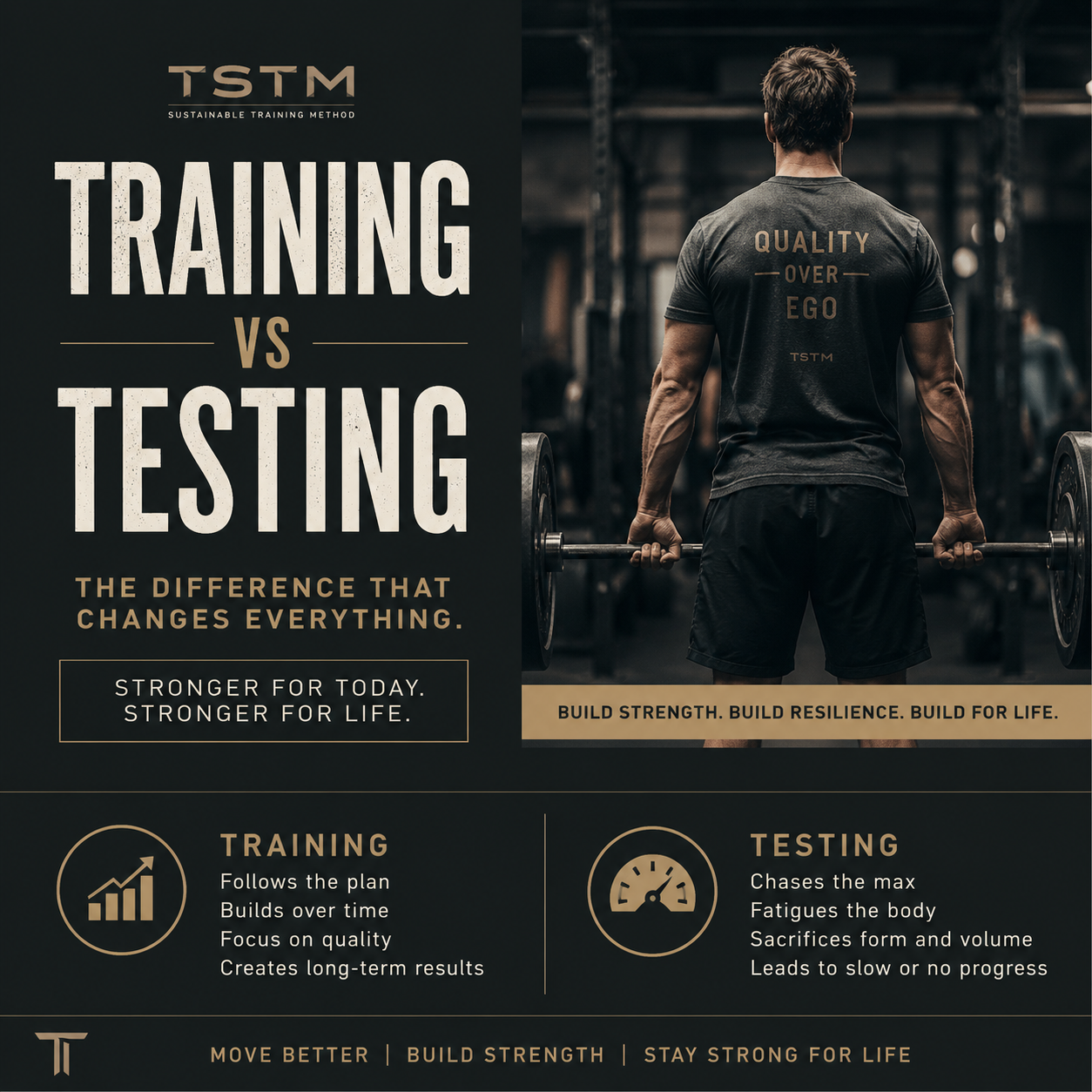
Training
Training is following a structured plan with a specific goal.
It means respecting the prescribed sets, reps, tempos, and intensity for the phase you’re in. It means accumulating quality work over time to build strength, movement efficiency, muscle, and resilience.
Training is about the long game.
Testing
Testing is trying to see how much weight you can lift today.
It’s pushing every set to the limit. Chasing personal bests constantly. Grinding reps. Letting technique fall apart just to complete the lift.
Testing gives you a snapshot of your strength on one particular day. Training builds strength for years. Most people think they’re training hard. In reality, they’re testing themselves over and over again.
The Problem With Chasing Weight Every Session
Let’s say your program calls for:
5 sets of 5 squats
A lot of people immediately load their true 5-rep max onto the bar and try to survive all five sets.
The workout ends up looking something like this:
Set 1: 5 reps
Set 2: 5 reps
Set 3: 4 reps
Set 4: 3 reps
Set 5: 2 reps
Instead of completing 25 quality reps, they complete 19 increasingly poor reps with worsening technique.
What happened?
Less total volume
Poor movement quality
More stress on joints and connective tissue
Increased fatigue
Less effective practice of the movement
And over time? Less progress.
This is where many people get stuck. They believe heavier automatically means better. But strength development is more nuanced than that.
Strength Is Built Through Quality Repetition
Strength isn’t just about moving more load.
It’s about:
Moving well
Building muscle
Improving coordination
Developing confidence under load
Increasing work capacity
Staying injury free
Maintaining strength for decades
That requires quality movement repeated consistently over time.
Rep after rep after rep.
The better we move, the more efficient we become. The more efficient we become, the more force we can produce safely. This is one reason movement quality matters so much.
If your goal is to still be strong, healthy, capable, and active in your 40s, 50s, 60s and beyond, you need to train smarter... not just harder.
Why Submaximal Loads Work Better
One of the biggest lessons I’ve learned over the years is this:
You do not need to fail reps to build strength.
In fact, for most people, constantly training to failure slows progress down.
Submaximal loads allow us to:
Move better
Improve technique
Build confidence
Increase training volume
Recover more effectively
Reduce stress on joints and connective tissue
Produce more force with better movement quality
Train consistently for years
Importantly, lighter does not mean easy. You should still be working hard.
But there’s a difference between challenging training and reckless training.
Most sessions should feel productive, not destructive.
The Missing Piece Most People Ignore: Acceleration
A concept I use often in programming is IMCA: Intended Maximal Concentric Acceleration.
In simple terms:
We want to move the weight as explosively as possible on the lifting phase of the movement while maintaining perfect form. This matters because strength is not only about mass.
Force production is:
Force = Mass x Accelleration
Most people only focus on the mass side of the equation. They assume strength only improves if the bar gets heavier. But acceleration matters too.
When the load is slightly lighter, we can move faster, recruit more motor units, and improve force production more effectively. Ironically, slightly reducing the load helps people become stronger faster.
This is why many elite athletes spend large portions of their training at submaximal intensities. Olympic weightlifters and powerlifters often spend most of their time training around 70–85% of their maximums.
They aren’t testing every session. They’re building capacity.
The Chinese Olympic lifting system is a great example. Young athletes may spend years rehearsing movement patterns with lighter loads before progressing to maximal weights.
They earn the right to lift heavy.
Progressive Overload Doesn’t Mean Maxing Out
Progressive overload is often misunderstood.
People think it means:
“Add more weight every week no matter what.”
But true progressive overload can also mean:
Better movement quality
Improved tempo control
More total volume
Better range of motion
Faster concentric speed
Better recovery between sets
Increased consistency
Sometimes the smartest thing you can do is keep the same weight and perform it better.
That is progress.
Why Tempo Matters
Tempo is one of the most underrated tools in strength training.
It creates consistency and delivers results.
If you squat fast one week and slowly the next, you’re no longer comparing the same movement. Tempo standardises execution so we can accurately track progress and maintain movement quality.
It also exposes weaknesses.
When we control tempo properly, we learn very quickly where stability, positioning, or structural balance is lacking. This allows us to train weaknesses rather than constantly hiding them behind heavier loads.
The Ego Problem
Ego is one of the biggest barriers to long-term progress.
We all want to feel strong. We all want personal bests. We compare ourselves to others. We watch social media clips of people grinding massive lifts. We convince ourselves that harder always equals better.
But sustainable strength doesn’t come from proving yourself every session. It comes from disciplined execution over years.
The truth is:
Most people are not patient enough to build strength properly.
Real strength takes time.
My Own Experience
When I first started lifting, I chased the weight on the bar constantly. I pushed to failure. I grinded reps. I thought I was training hard. And to be fair, I did get stronger.
But progress was slower than it needed to be.
My technique would break down. I’d miss reps. I’d accumulate fatigue unnecessarily. It wasn’t until I got older, worked with better coaches, and learned more about intelligent programming that I realised something important:
Load is not always the best variable to chase. Quality is.
Once I started focusing more on movement quality, submaximal loading, structured phases, and long-term progression, everything improved.
I became stronger. More confident. Built more muscle. Moved better.
And now, in my 40s, I feel stronger and healthier than I did in my 20s and 30s.
I’ve seen the same thing happen with clients.
When people stop trying to prove themselves every session and start respecting the process, they build strength more sustainably, improve body composition, reduce pain, and enjoy training again.
Final Thoughts
The goal of training is not to impress people for one workout. The goal is to build a body that remains strong, capable, resilient, and healthy for life.
That requires patience. It requires consistency. It requires movement quality.
And sometimes it requires putting the ego aside long enough to realise that smarter training beats harder training in the long run.
Train to build strength.
Don’t just test it.
If this style of training resonates with you; structured programming, movement quality, sustainable strength, and long-term progress... I’ll soon be coaching from Byron Gym in Byron Bay. Or I also offering online coaching for those wanting a more personalised approach to training.
The goal isn’t simply to help you lift heavier.
It’s to help you move better, build real strength, stay injury free, and continue improving your body, health, and confidence for years to come.
Because great training shouldn’t just make you stronger today.
It should keep you strong for life.