
The Cardio Trap: Why Doing More Isn’t Making You Healthier
In the last article, we spoke about why muscle is one of the most important drivers of long-term health, performance, and longevity.
It influences everything from metabolism and blood sugar control to strength, resilience, and how well you age.
But there’s a problem.
Most people are not lacking effort.
They’re lacking direction.
And one of the biggest reasons for that is how much emphasis is placed on cardio.
The Cardio Misunderstanding
Cardio isn’t the enemy.
Walking, basic aerobic fitness, and general movement all play an important role in overall health.
But in modern fitness culture, cardio has become over-prioritised and often misunderstood.
Many people spend the majority of their training time:
in classes
doing circuits
chasing sweat
trying to burn calories
They leave sessions feeling exhausted… but not necessarily improved.
Because fatigue is not the same as progress.
When “High Intensity” Isn’t Really High Intensity
A lot of what is marketed as high-intensity training today isn’t truly high intensity.
It’s extended effort.
Circuits, bootcamps, and many group classes often keep people working continuously for several minutes at a time with minimal rest.
That shifts the body into a predominantly aerobic state.
And while that has value in the right context, it’s not the most effective way to build muscle or strength.
Building muscle requires:
sufficient load
controlled execution
recovery between sets
progressive overload over time
Without those elements, the body doesn’t get the signal it needs to adapt. Although you're training "hard" you not seeing any real progress.
The Cost of Doing Too Much Aerobic Training
The issue isn’t just that this style of training is less effective for building muscle.
It’s that doing too much of it can work against you.
Many people are already:
stressed from work and life
under-recovered
not sleeping enough
under-eating or under-fuelling
Layering high volumes of cardio and constant-intensity training on top of that can lead to:
persistent fatigue
stalled progress
reduced strength
difficulty building or maintaining muscle
increase injury
Over time, that becomes a problem.
Because muscle is the very thing that supports long-term health.
A Simple Way to See It
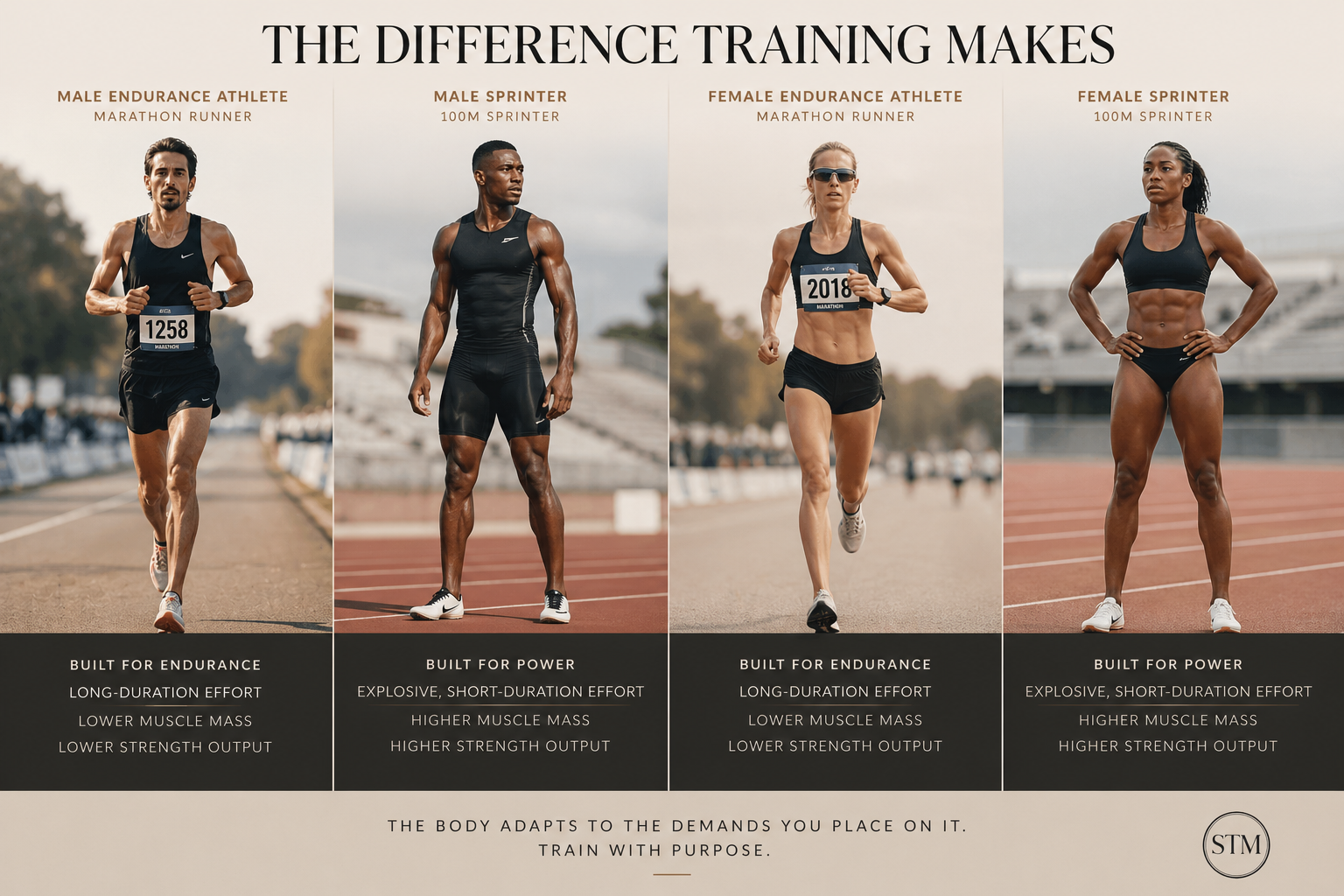
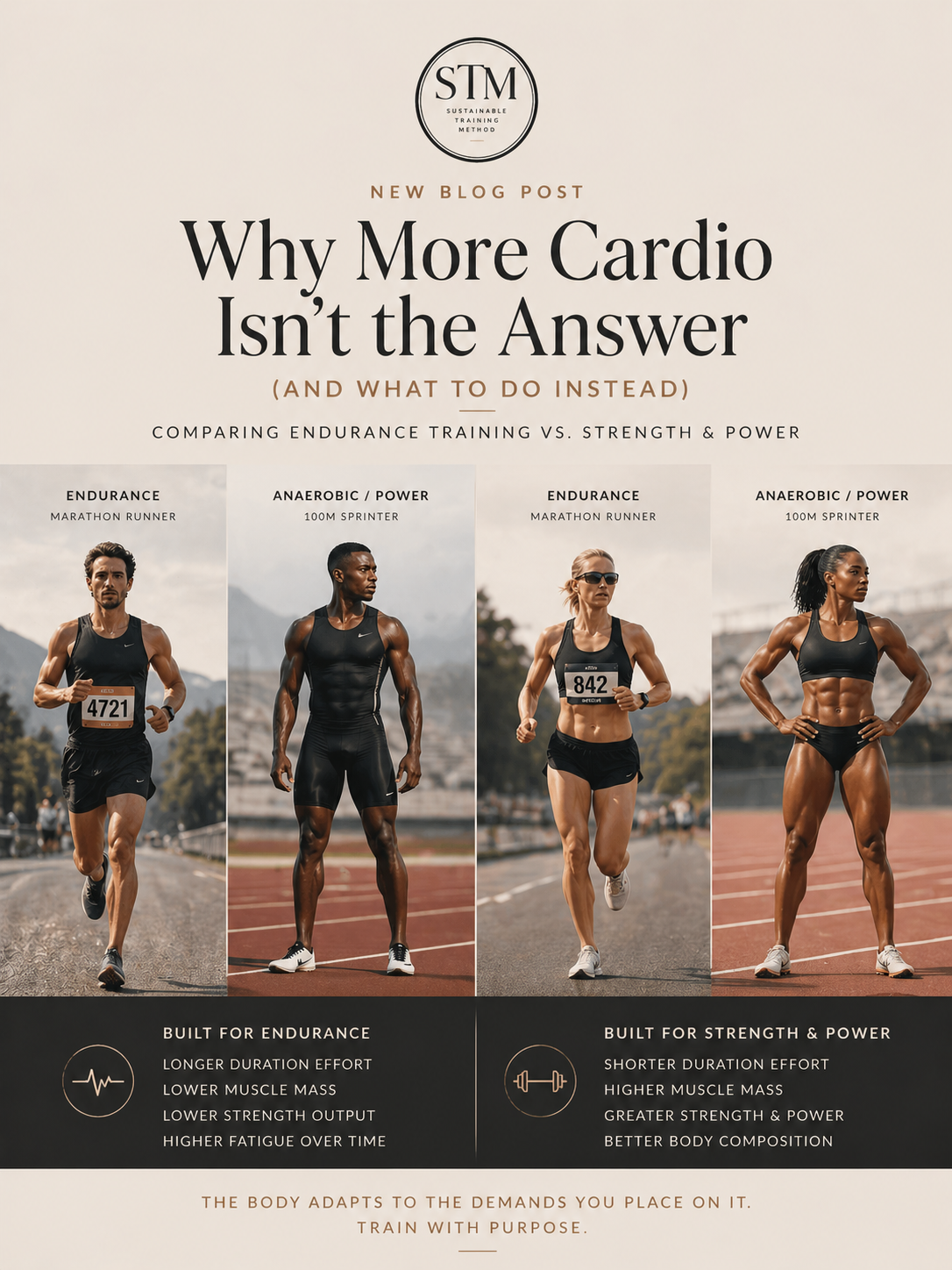
You don’t need to look far to see how different types of training shape the body.
Sprinters, who train for short bursts of power and strength, tend to be:
muscular
strong
explosive
Endurance athletes, particularly at longer distances, tend to carry significantly less muscle mass.
That’s not a criticism. It’s a reflection of the demands of their sport.
But it highlights an important point:
The body adapts specifically to the type of stress you place on it.
If most of your training is long-duration, lower-intensity work, your body will adapt in that direction.
My Experience
This is something I learned the hard way.
I spent years training as a triathlete.
Marathons, long endurance sessions, hours of aerobic work.
At the time, I believed this was the pinnacle of fitness.
And in some ways, it is impressive.
But over time, I started to notice:
lower energy
constant fatigue
poor recovery
declining strength
Despite doing more, I wasn’t actually moving forward.
It wasn’t until I shifted my focus toward strength training, and learned from coaches like Charles Poliquin, that things began to change.
I started training with more structure. More intent. More recovery.
And the results followed.
The Shift That Changes Everything
The goal isn’t to eliminate cardio.
It’s to put it in the right place.
For most people, that looks like:
daily low-stress movement (like walking)
maintaining a base level of aerobic fitness
but prioritising strength training
Because strength training does something very few other methods can:
It builds muscle.
And muscle is what supports:
metabolism
energy
resilience
long-term health
What To Focus On Instead
If your goal is to feel better, perform better, and age well:
Focus on:
lifting weights consistently (2–4 times per week)
progressing gradually over time
prioritising recovery between sessions
eating enough to support training
sleeping properly
And instead of asking: “How many calories did I burn?”
Start asking: “Am I getting stronger?”
Final Thought
You don’t need more exhaustion.
You don’t need more random workouts.
And you don’t need to spend hours chasing fatigue.
You need a clear signal.
Build muscle. Support recovery. Train with intent.
Because how you train today is shaping how you’ll live later.