How to Train Smarter in Midlife, Not Just Harder
In your 20s and 30s, effort is simple. More feels better. More volume, more intensity, more sessions. You recover quickly, your schedule is looser, and your identity is still trying to prove something to yourself and to the world. That’s the Warrior phase. And in that phase, “train harder or go home” works often enough that it becomes the default belief.
But midlife changes the equation. Not just physically, but structurally.
You’re carrying more... responsibility, decisions, pressure, time constraints. Your recovery is no longer just about muscles; it’s tied to sleep, stress, work demands, and the mental load you carry day to day. You can still push, but pushing now has a cost that didn’t exist before, or at least not in the same way.
And this is where a lot of men get caught.
They try to apply a younger man’s training philosophy to an older man’s life. The result isn’t better progress. It’s inconsistency, fatigue, and often injury.
There’s solid research that supports this shift. Studies have shown that during high-stress periods (like exams) injury rates increase significantly, even when training itself doesn’t change [1]. What changes is the total stress load the body is carrying. The nervous system is already under pressure, and additional training stress pushes it past what it can recover from.
Other research shows that people under higher stress are more likely to get sick [2], and that negative life stress, not just physical training stress, is linked to higher injury risk [3].
That principle doesn’t become less relevant as we age. It becomes more relevant.
Because in midlife, high stress isn’t a one-week event. It can be a season of life.
So the conversation shifts.
It’s no longer just: How hard can I train?
It becomes: What can I recover from?
This is where the idea of capacity starts to matter.
Your body has a current capacity... a level of training volume, intensity, and frequency that it can absorb and adapt to. Train within that, and you get stronger. Train beyond it, especially repeatedly, and you start to accumulate fatigue faster than you can recover.
But there’s a direction most men don’t think about.
Capacity doesn’t just build, it also declines.
If you stop training, or avoid it altogether, your body adapts to that too. Strength drops. Resilience fades. And over time, you don’t just lose performance, you lose independence.
No man in his 40s thinks that’s where he’s heading. But enough years of neglect, and you end up needing help for things you’d rather handle yourself.
The flip side is just as real.
When you train consistently, and train appropriately, your capacity expands. Things that once felt hard start to feel manageable. Things that felt heavy feel lighter. You don’t just get stronger in the gym, you become more capable in your life.
Your ability to handle stress improves. Your resilience increases. You carry yourself differently, because you are different.
Strength training is hard work. But that’s the point.
The effort you invest in the gym makes both physical and mental demands outside of it easier to carry.
And that’s why, in Midlife Mavericks, we see strength as the gateway habit. Not because it makes you look and feel better (though it does), but because it rebuilds your capacity to live well.
The mistake is thinking capacity is fixed. It’s not.
Capacity can be built, but it’s built gradually, over months and years, not forced in a few aggressive weeks. And it’s built not just through training, but through how you support that training: sleep, nutrition, stress management, and how well your life is structured around it.
This is where the shift from Warrior to King begins to show up in training.
The Warrior tries to prove himself through effort. The King takes responsibility for outcomes.
And that means thinking differently.
Training smarter doesn’t mean training soft. It doesn’t mean avoiding effort or lowering standards. Strength still matters. In fact, in midlife, it matters more. It remains the gateway habit, the thing that restores discipline, energy, and self-respect.
But the approach becomes more deliberate.
You choose your volume with intent. You choose your frequency based on your life, not your ego. You adjust intensity based on what’s happening outside the gym, not just inside it.
You still train hard. But you train in a way that you can recover from... consistently.
Because in midlife, consistency beats intensity every time. And maybe that’s the real shift this stage of life asks for:
Not less effort… but better judgment about where that effort goes.
“How to Train Smarter”
At some point, “train smarter” has to mean something practical.
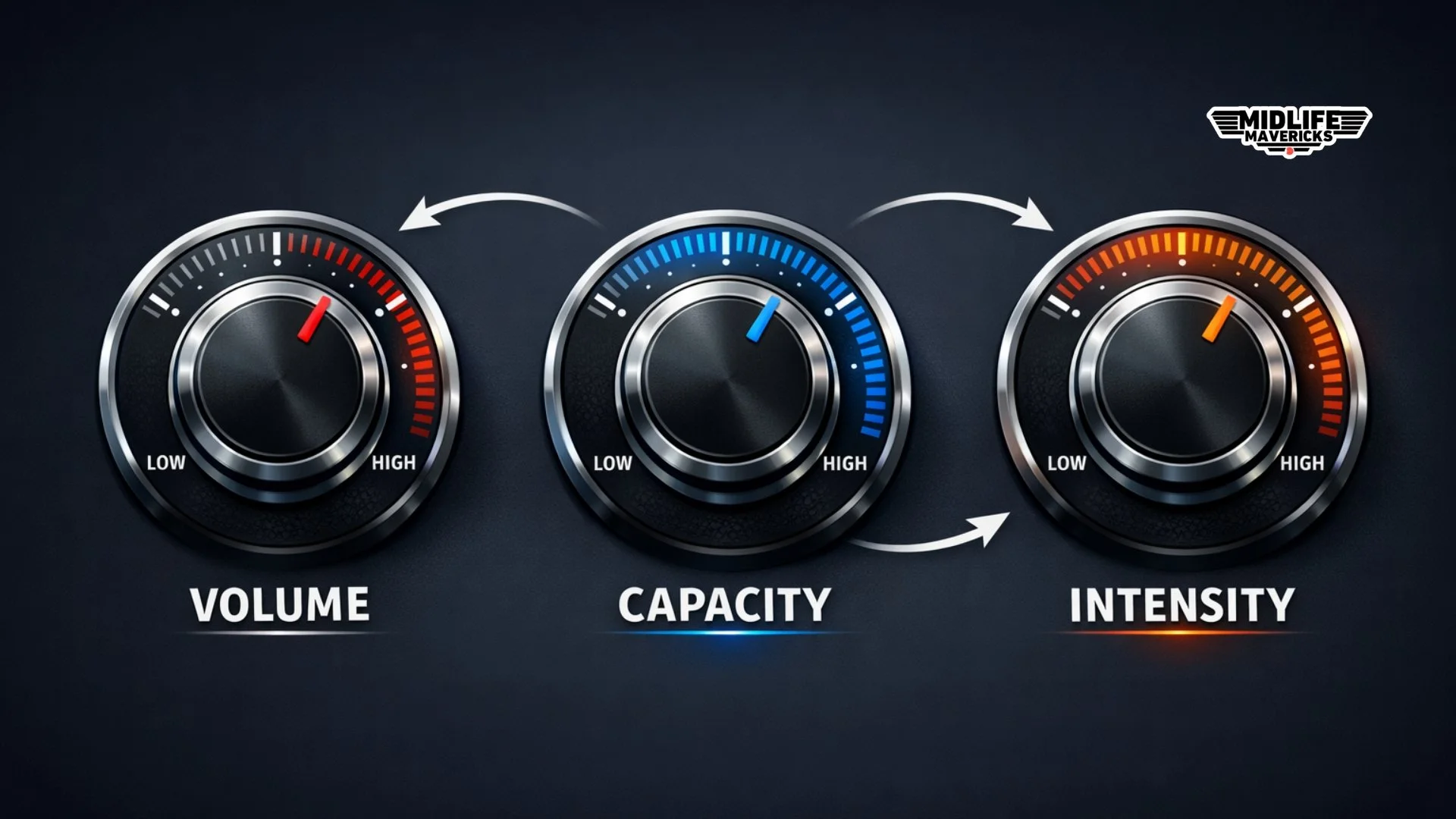
And most of it comes down to understanding three levers you can actually control:
How often you train. How much work you do. And how hard you push.
That’s it.
In training terms, those are called frequency, volume, and intensity. But you don’t need to get lost in the terminology. You just need to understand what they mean in your life.
Frequency is simply how many times you train each week. For most men in midlife, this is where reality needs to come first.
Two sessions a week will maintain strength.
Three sessions will build it.
Four sessions is strong, but only if your life can support it.
The mistake is choosing a frequency your life can’t sustain.
"A good program you can stick to will always beat a perfect one you can’t.”
Because the best program on paper means nothing if you can’t show up consistently.
Volume is the amount of work you do in a session.
Work ≈ Load × Reps (× Sets)
So practically:
100 kg × 5 reps × 3 sets = 1,500 kg of work
60 kg × 12 reps × 3 sets = 2,160 kg of work
In simple terms, it’s how many sets and reps you perform.
Higher volume means more work. Lower volume means less.
Volume is essentially your total work done in each session.
There are times where pushing volume makes sense; building muscle, improving work capacity, improving movement quality, getting your body used to training again.
And there are times where less is more; when stress is high, recovery is limited, or you simply need to maintain.
Intensity is how heavy you’re lifting, relative to your maximum.
In simple terms, it’s the percentage of your one-rep max. The closer the weight is to your maximum, the higher the intensity.
But this is where a lot of men get confused. Something can feel hard… without being high intensity.
If you’re doing a set of 12 reps and it burns, that’s not high intensity. That’s moderate intensity with high effort. The weight on the bar simply isn’t heavy enough to be considered true high-intensity strength work.
High intensity shows up differently.
It’s lower reps. Heavier weight. Longer rest.
Think six sets of three reps. The weight is high, the reps are low, and the demand shifts from the muscles to the nervous system. That’s where real strength is built.
So now you have to understand how these pieces fit together.
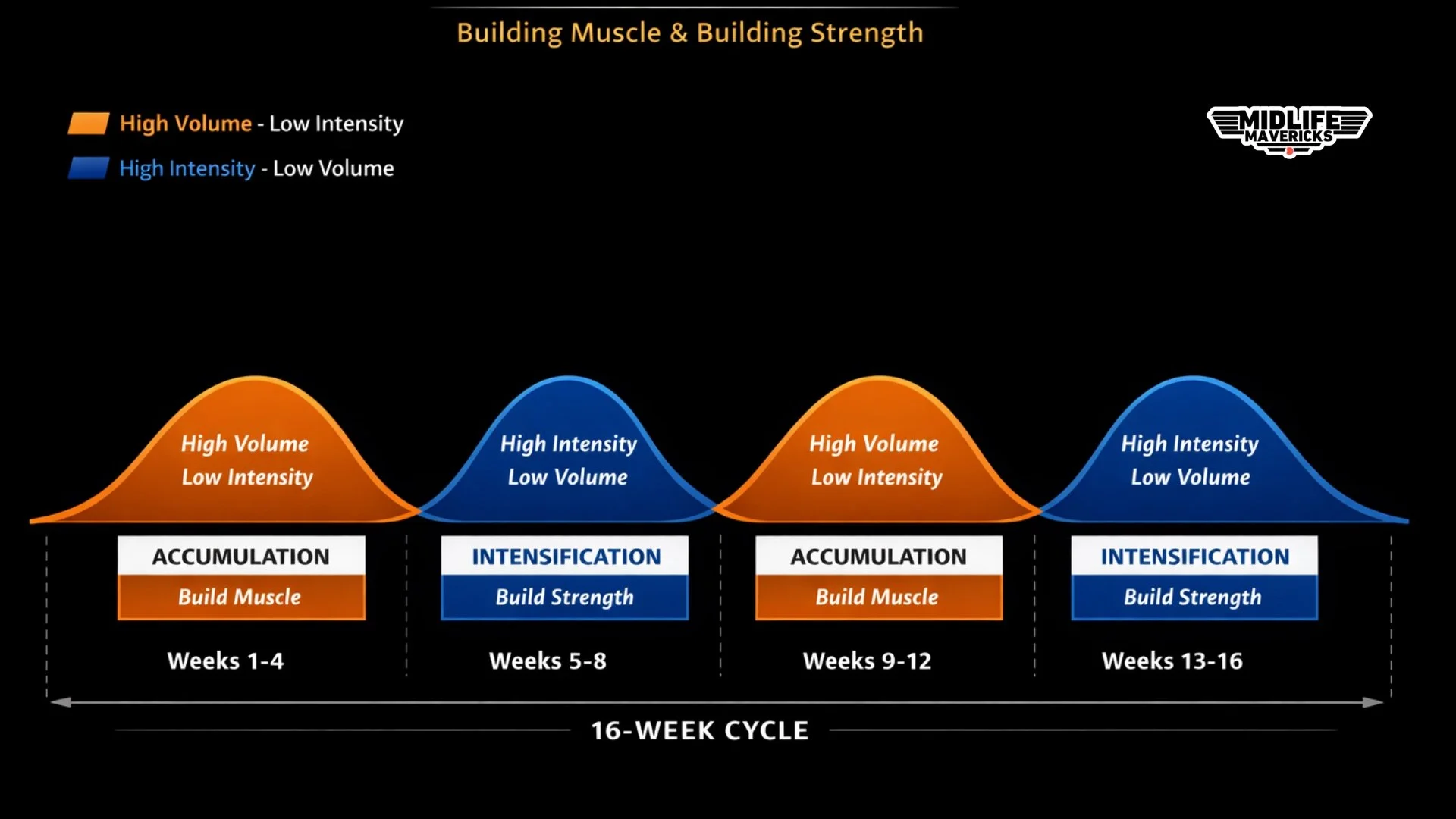
Higher reps, more volume → moderate intensity → builds muscle (Accumulation Phase)
Lower reps, heavier weight → high intensity → builds strength (Intensification Phase)
Both matter.
But you can’t push both at the same time.
👉 If volume is high, intensity has to come down. 👉 If intensity is high, volume has to come down.
Because they create fatigue in different ways.
Volume breaks the body down through accumulation. Intensity taxes the nervous system through load.
Trying to push both at the same time (high volume and high intensity) is where most men run into trouble.. Especially in midlife.
Capacity = how much work you can do and recover from over time.
Capacity ≈ Work/Time
You’re not just trying to survive hard sessions. You’re gradually increasing what your body can handle, physically and mentally.
Some phases challenge the muscles more. Others challenge the nervous system more.
And over time, both improve. You become stronger. But just as importantly, you become more capable.
So how do you actually use this?
You stop thinking session to session… and start thinking in 12–16 week cycles, built from 3–4 week blocks. Some blocks focus on higher volume and moderate intensity. Others focus on lower volume and higher intensity.
Not complicated phases. Just intentional ones.
There are periods where the focus is on building muscle and losing fat; more reps, more control, more time under tension. You’re not chasing maximum weight. You’re building the base.
And there are periods where the focus shifts to higher intensity; fewer reps, heavier weights, more intent. You’re asking your body to express the strength you’ve built.
They work together. One builds the engine. The other teaches you how to use it.
The mistake most men make is chasing intensity all the time. Lifting heavy. Pushing hard. Trying to prove something every session.
That’s the Warrior mindset. And it works… for a while.
But in midlife, it catches up with you. The smarter approach is to step back and ask:
What is my life able to support right now?
Then build your training around that.
Because this is the shift:
You’re no longer training to win the session.
You’re training to win the year.
And eventually, the next decade.
A Simple 16-Week Example
Phase 1: Accumulation (Weeks 1–4) This is where you build the base.
4 sets of 10 (40 reps total)
~70–75% of your max
Shorter rest (around 60–90 seconds)
You’re not chasing heavy weight here. You’re building volume. Control. Work capacity.
Phase 2: Intensification (Weeks 5–8) Now you shift toward strength.
5 sets of 6 (30 reps total)
~80–85% of your max
Longer rest (90–120 seconds)
Less volume, more weight. You start asking your body to produce force, not just tolerate work.
Phase 3: Accumulation (Weeks 9–12) Back to building, but at a higher level of volume than weeks 1-4.
4 sets of 12 (48 reps total)
~65–70% of your max
Shorter rest again
The volume increases here. You’re doing more work than before, because your capacity has improved.
Phase 4: Intensification (Weeks 13–16) This is where strength peaks.
5 sets of 5 (25 reps total)
~85%+ of your max
Longer rest
Lower reps. Heavier weight. You’re now stronger than you were earlier in the cycle
What’s Actually Happening Here
You’re not just training. You’re building capacity in layers.
The accumulation phases build muscle and work capacity
The intensification phases build strength and efficiency
Each phase supports the next.
You build the engine. Then you learn to use it.
Then you come back and build a bigger one.
Why This Matters in Midlife
This approach does something most men miss.
It respects recovery.
You’re not trying to push maximum intensity all the time. You’re not trying to prove something every session.
You apply stress… adapt… then progress.
Gradually.
Deliberately.
In a way your body can actually sustain.
“You don’t get stronger by going all out. You get stronger by applying the right stress, at the right time, and recovering from it.”
At some point, this stops being about training. It becomes about how you choose to live.
Midlife is where a lot of men start to feel the gap. Between where they are… and where they know they could be.
Less energy. Less strength. Less capacity than they once had.
And for a lot of men, the instinct is either to ignore it… or to try and push harder, the way they used to.
But neither path really works.
What does work is taking responsibility for it.
Rebuilding strength. Restoring energy. And doing it in a way that actually fits the life you’re living now.
That’s the shift from Warrior to King.
The Warrior trains to prove something. The King trains to become someone.
And it starts here.
With something simple. Consistent. Deliberate.
If you’re new to training, or coming back after time away, you don’t need complexity. You need a place to start.
Inside the Midlife Mavericks Brotherhood, we focus on the foundation; strength first. Two days a week. Simple structure you can actually stick to while you rebuild your capacity.
If you’re already training and want more structure, something you can follow without overthinking it, the Midlife Mavericks Team program gives you that next level. A clear plan, built around this exact approach.
And if you want guidance, accountability, and a program built specifically for your life, you can apply for one-to-one online coaching.
Wherever you’re starting from, the principle is the same.
Start where you are. Train with intent. Build your capacity.
Because the goal isn’t just to train harder.
It’s to build a body, and a life, that can carry what midlife asks of you.