The 8 Foundational Strength Movements Every Adult Should Master
Strength training is not random exercise. Unfortunately, modern fitness culture often treats it that way. People jump between random workouts, constantly chase calorie burn, spend hours doing excessive HIIT circuits, and endlessly search for the newest exercise trend... all while never becoming truly strong, structurally balanced, or physically capable.
The goal of training should not simply be to feel exhausted. The goal should be to build a body that is strong, resilient, capable, healthy, and able to perform well for decades.
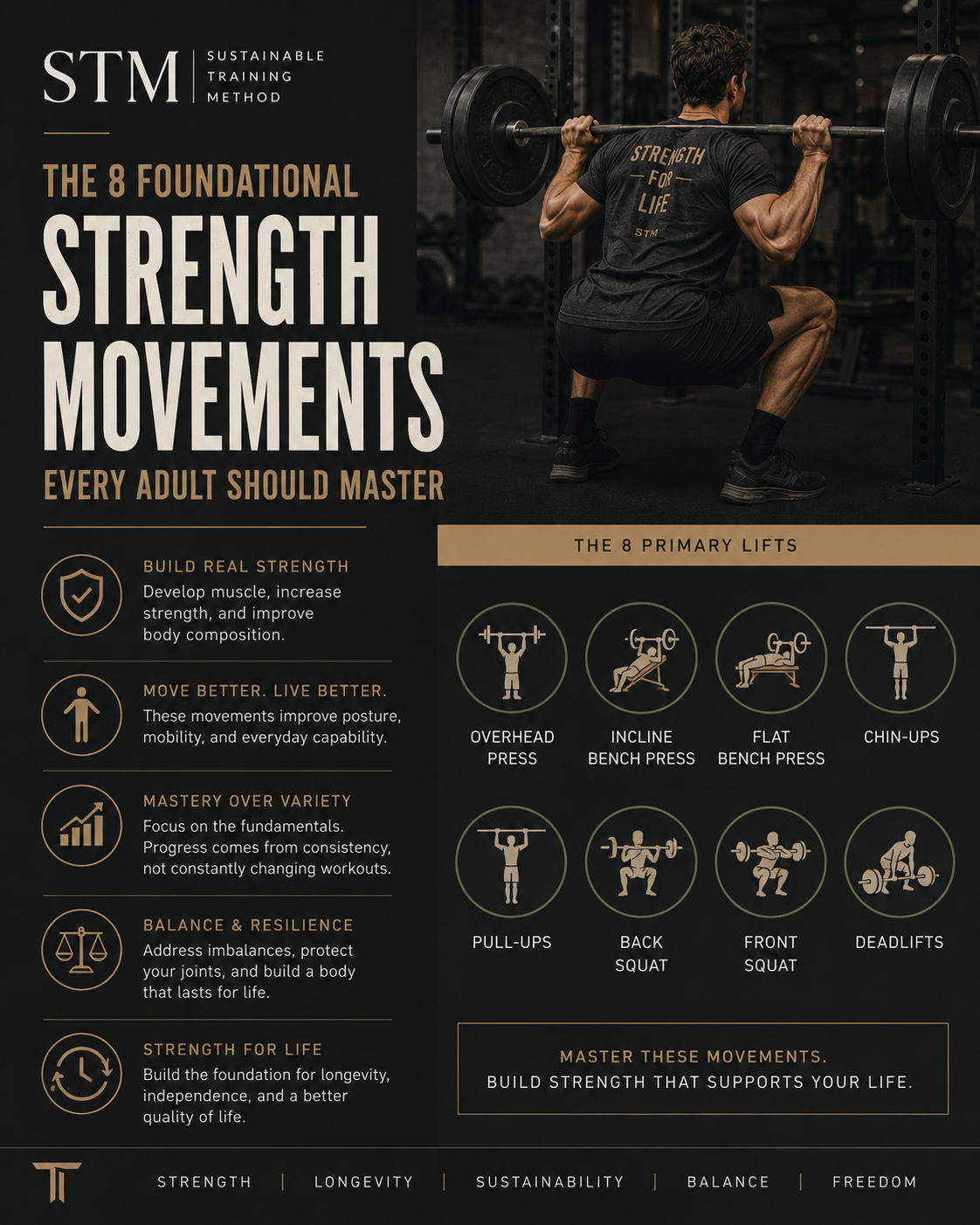
At the center of that goal are a small number of foundational movement patterns that consistently deliver the greatest return for strength, muscle development, posture, longevity, joint health, and day-to-day capability.
These movements are:
Overhead Press
Incline Bench Press
Flat Bench Press
Chin-Ups
Pull-Ups
Back Squat
Front Squat
Deadlift
These are not just exercises. They are foundational human movement patterns that every adult should strive to own.
Why These Movements Matter
These lifts have stood the test of time because they work. They train the body as an integrated system rather than isolating individual muscles in isolation. They require coordination across multiple joints and muscle groups, forcing the body to move efficiently and produce force in a balanced way.
These movements:
Build the most muscle
Develop the greatest overall strength
Improve posture and structural integrity
Strengthen connective tissue and joints
Improve movement quality and coordination
Help reduce injury risk
Increase confidence and physical capability
Support long-term health and independence
Most importantly, these movements carry over directly into real life.
A strong squat pattern helps you sit down and stand up with ease.
A strong deadlift helps you safely lift heavy objects off the floor.
Strong pulling movements improve posture and upper body balance.
A strong overhead press helps you lift, carry, and control objects overhead with confidence.
These are not just gym movements. They are human movements.
The Problem With Modern Fitness Culture
Many people spend years chasing fatigue instead of progress. Workouts are often built around sweat, exhaustion, and calorie burn rather than measurable improvements in strength, movement quality, and muscle development.
High-intensity interval training certainly has its place, but it is often overused.
Excessive HIIT performed at submaximal loads and high volumes creates large amounts of fatigue and stress without necessarily building meaningful strength or muscle. Many people end up tired, sore, inflamed, and under-recovered while never developing the physical foundation they actually need.
Muscle and strength are not built through random exhaustion. They are built through progressive overload, movement mastery, quality execution, and consistent practice of foundational patterns.
Most people do not need more exercise variety. They need more mastery.
Why These Movements Should Come First In Training
In most strength programs I write, the session revolves around one or two primary movements.
Everything else supports them.
Primary movements are placed first in the session because:
Energy and focus are highest
The nervous system is freshest
Coordination and movement quality are best before fatigue accumulates
These lifts require the most concentration and technical precision
Accessory and pre-hab exercises are important, but they should support the foundational lifts, not replace them. Rows, split squats, lunges, curls, tricep work, shoulder external rotation work, trap 3 raises, chest flies, leg press variations, abdominal training, and mobility work all have value.
But they are assistance and pre-hab work.
The primary goal is still improving and maintaining the foundational movement patterns that provide the greatest long-term return.
Strength, Structural Balance, and Injury Prevention
One of the biggest benefits of these movements is that they expose weaknesses and imbalances. When someone struggles with one of these patterns, there is usually an underlying limitation:
Poor mobility
Lack of stability
Weakness in certain muscle groups
Poor posture
Loss of control through certain ranges of motion
Structural imbalances between movement patterns
This is where intelligent coaching becomes important. When I work with clients, my first objective is teaching them how to unlock these movements with proper technique and control.
From there, we identify their limiting lifts and weakest movement patterns. Often, improving the weakest movement improves strength and performance across multiple other lifts.
For example:
A weak front squat may reveal poor core strength, upper back weakness, or limited ankle mobility
Poor overhead pressing often reflects tight lats, pecs, and biceps combined with weak shoulder stabilisers and upper back muscles
Weak pulling strength relative to pressing strength often contributes to poor posture and shoulder discomfort
Weak posterior chain strength often affects squatting mechanics and lower back resilience
These weaknesses and imbalances are often what eventually lead to pain, compensation patterns, and injury. A good strength program identifies these weak links early and systematically improves them.
Mobility Is Earned Through Strength and Control
Mobility plays a major role in performing these movements well. Many busy professionals spend long days sitting, driving, or working hunched over a computer. Over time, this often leads to:
Tight hips
Limited ankle mobility
Poor thoracic extension
Rounded shoulders
Weak glutes
Weak upper backs
Loss of overhead range of motion
All of these issues directly affect the quality of the foundational lifts. But mobility is not just about stretching. Mobility is earned through strength and control.
If the body does not feel stable or strong in a certain position, it will avoid that range. This is why simply stretching without improving strength often produces limited long-term results.
The goal is to build strength and control through full ranges of motion. Once people earn the mobility to perform these movements properly, regularly training them helps maintain that mobility.
Sometimes targeted mobility work is helpful, but strength training itself is often one of the most effective long-term mobility tools available.
If You Cannot Perform These Movements Yet, Your Program Should Move You Toward Them
Not everyone can perform all of these movements perfectly from day one. That is completely normal. The goal is not perfection immediately. The goal is progression.
A good program should identify what is preventing someone from performing these patterns correctly and systematically work toward improving it.
For example:
Someone lacking ankle mobility may begin with heels-elevated squat variations or cyclist squats
Someone struggling with chin-ups may start with eccentric variations and scapular strength work
Someone lacking overhead mobility may benefit from thoracic mobility work, shoulder stability work, and targeted upper back strengthening
Someone with limited hip mobility may need goblet squats, split squats, and controlled tempo work before progressing further
Regressions are not failures. They are tools used to build competency. The objective is always to move closer toward owning the full movement pattern with strength, control, and confidence.
Strength Is One of the Most Protective Qualities Humans Can Build
Strength training is not just about aesthetics. It is one of the most protective things we can do for long-term health and quality of life. As we age, people naturally lose muscle mass, strength, coordination, and bone density.
This loss of muscle (known as sarcopenia) contributes heavily to frailty, injury risk, reduced independence, and declining quality of life later in life. Building and maintaining strength helps protect against this.
Strength supports:
Independence later in life
Joint health and resilience
Bone density
Posture and movement quality
Confidence and physical capability
Metabolic health
Injury resilience
Everyday functionality
I explore this further in my article:
Why Muscle Matters: The Missing Foundation of Health, Longevity, and Energy
Build Strength That Supports Your Life
The goal of training should not be to survive random workouts. The goal should be to build a body that supports your life.
A body that is:
Strong
Capable
Balanced
Resilient
Athletic
Confident
Healthy
Durable for decades to come
These 8 foundational movements consistently deliver the greatest return for building that kind of body. Not because they are trendy. But because they work.
Mastering these patterns takes time. It requires patience, discipline, coaching, and consistent practice. But the reward is enormous.
Most people do not need more exercise variety. They need more mastery of foundational movement patterns.
Build strength that supports your life, not just your workouts.
How to Unlock These 8 Movements
If you want to build real strength, improve movement quality, and develop a body that stays capable and resilient for life, I’d love to help.
I work with busy professionals both in-person at Byron Bay and online, helping clients build strength, muscle, mobility, and long-term health through intelligent, sustainable training.
Whether you’re starting from scratch, returning from injury, or looking to take your training to the next level, the goal is the same: build a stronger body that supports your life for decades to come.
To get started, book a consultation call and we’ll discuss your goals, training history, limitations, and the best approach for you.