Hydration: The Foundation of Nutrition
"Every goal you have for your health; more energy, better performance, faster recovery, building muscle, losing fat... depends on one thing that most people overlook: hydration."
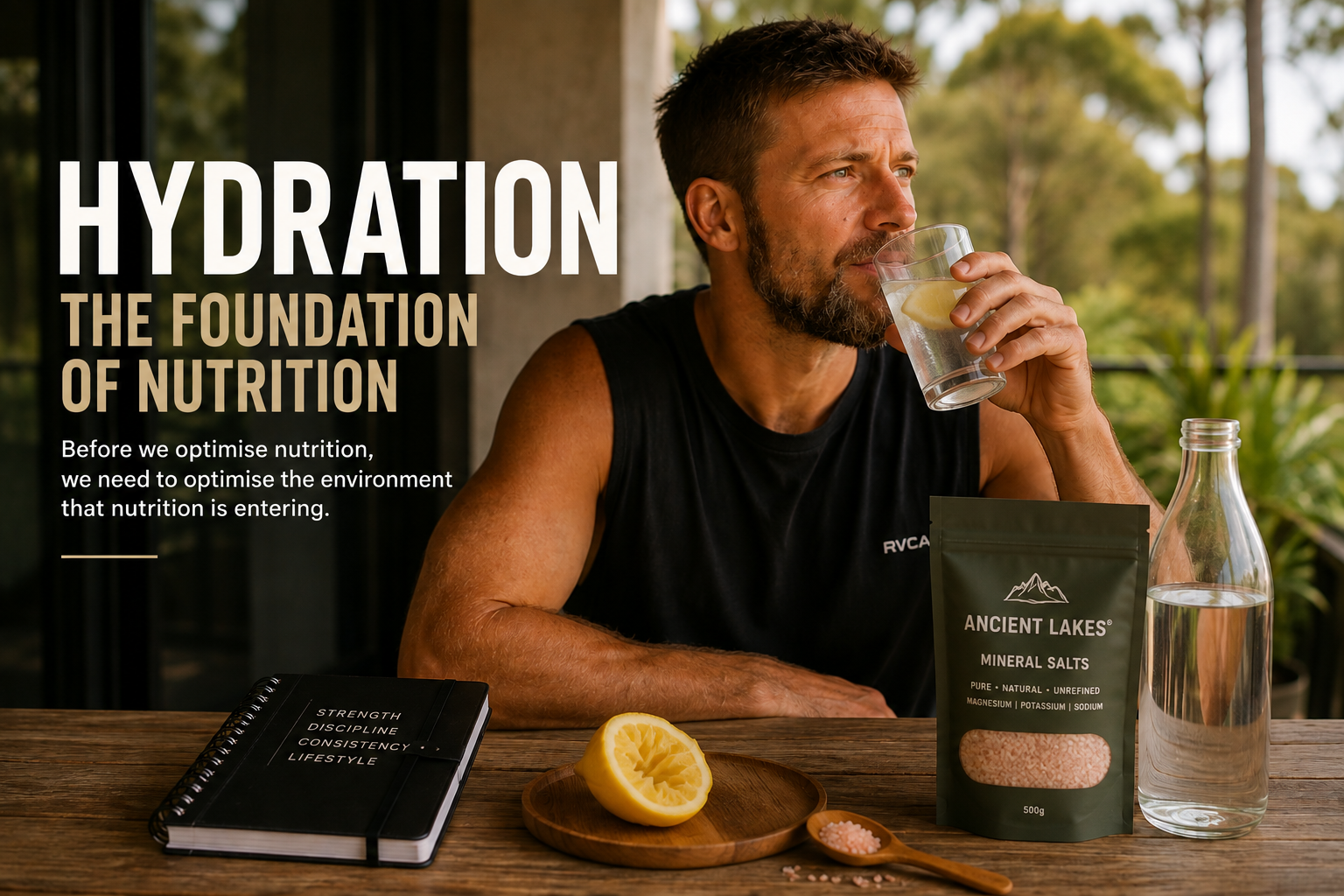
"If I could change just one thing about your nutrition today, it wouldn't be your protein intake. It wouldn't be your calories. It wouldn't even be your breakfast. It would be the volume and quality of the water you drink."
That probably surprises people.
After all, we live in a world obsessed with high-protein diets, supplements, fasting, calories and the latest nutrition trends. Yet, after years of coaching clients, I've found one of the most overlooked reasons people feel tired, flat, foggy and underperform isn't complicated at all.
They're simply not drinking enough quality water.
The interesting part?
Most people don't even realise they're dehydrated because it's become their normal. I've lost count of the number of clients who've come back after just a week or two of focusing on hydration and said:
"I didn't realise how much better I could feel."
They have more energy.
Their headaches disappear.
Their concentration improves.
They recover better from training (less DOMS).
Their digestion becomes more regular.
They simply feel more like themselves again.
That's why hydration is always a conversation I have with my clients.
Before we optimise nutrition, we need to optimise the environment that nutrition is entering, and that starts with quality water.
Your Body Is Like a City
Imagine you're the mayor of a thriving city. You invest millions of dollars into building world-class hospitals, beautiful parks, modern schools and incredible sporting facilities.
You build great roads. Reliable public transport. State-of-the-art businesses. Everything looks amazing.
But there's one problem.
The city doesn't have a reliable water supply.
How long do you think that city survives?
Businesses close. Hospitals can't operate. Parks dry out. People become sick. Eventually, nobody wants to live there. Without water, the entire city begins to fail.
Your body works exactly the same way. You can eat the best diet. Follow the perfect strength program. Take premium supplements. Get eight hours of sleep every night. But if you're chronically dehydrated, every system in your body isn't functioning optimally.
Quality Water: The Most Overlooked Nutrient
We often think about nutrients as protein, carbohydrates, healthy fats, vitamins and minerals. But the nutrient your body needs more than any other is water. Around 50–70% of your body is made up of water, depending on your age, sex and body composition.
Your muscles are approximately 75% water.
Your brain is around 75% water.
Even your bones contain significant amounts of water.
Every second of every day your body is using water to:
Transport nutrients to your cells.
Remove waste products.
Regulate body temperature.
Lubricate your joints.
Support healthy blood flow.
Produce digestive juices.
Absorb nutrients from food.
Maintain healthy blood pressure.
Support brain function.
Keep your skin healthy.
Assist kidney function.
Quite literally... Every cell in your body depends on water. When you're dehydrated, every one of these systems becomes less efficient. That's why dehydration doesn't just make you thirsty. It affects everything.
Hydration Isn't Just About Preventing Dehydration
Most people think hydration is simply about avoiding thirst. I think it's much bigger than that.
Hydration is about creating the internal environment your body needs to perform, recover and thrive.
Think about it.
Every workout you complete... Every meal you eat... Every hour you sleep... Every muscle you build... Every kilogram of body fat you lose... Depends on the environment inside your body.
If that environment is constantly running low on quality water, your body has to work harder just to do the basics. Hydration isn't about surviving. It's about giving your body the best opportunity to perform at its highest level.
Why So Many People Feel Better When They Start Drinking Quality Water
One of the things I've noticed over years of coaching is how quickly people notice the difference.
Someone who has been drinking one litre of tap water a day suddenly starts drinking two or three litres of mineralised water consistently. Within a week or two they often tell me:
"I've got more energy."
"I'm thinking more clearly."
"I don't feel as tired in the afternoon."
"My workouts feel better."
"I'm not getting headaches anymore."
"My digestion has improved."
Is mineralised water solely responsible for every one of those improvements? Probably not.
When people begin working with me, they're usually improving several habits at once. But hydration is almost always one of the first habits we address, and it's often one of the first changes they actually notice.
That's why I believe it deserves far more attention than it gets. Not because it's exciting. Because it's foundational.
Start Your Day With Quality Water
One of the simplest habits I recommend to almost every client is to drink mineralised water before anything else in the morning. Think about it.
You've just gone seven or eight hours without drinking. Your body wakes up needing fluids. Yet many people reach straight for coffee. Instead, I encourage clients to start the day with around 300–500 mL of mineralised water before their first coffee or even breakfast.
Personally, I add mineral salts and juice from a fresh lime or lemon to mine, which we'll talk more about in a future article on electrolytes. It's a simple habit, but it sets the tone for the rest of the day.
Before caffeine. Before emails. Before breakfast. Hydrate your body first. It's one of the easiest wins you can have every morning.
It's Not Just About How Much Water You Drink
Here's where I think hydration becomes a little more interesting. Most conversations focus on how much water we should drink. I think we should also be asking another question:
What is the quality of the water we're putting into our bodies?
This is where my approach differs from many people, and it's something I've thought a lot about over the years. We all know our environment influences our health. We think about the quality of the food we eat. The air we breathe. The products we put on our skin.
So why wouldn't we also think about the quality of the water we're consuming every single day?
For me, hydration isn't just about quantity. It's about quality too.
Why I Choose to Filter My Water
This is my personal approach, and it's one that's evolved over many years. Unfortunately, Australian tap water is treated with chlorine to reduce harmful bacteria, and many water supplies also contain fluoride as part of "public health programs."
Personally, I choose to filter both out.
Why?
Because my philosophy has always been simple. You wouldn't drink a chlorine or fluoride straight out of the bottle, it'll make you sick. So, why do assume that drinking diluted amounts is ok? It's death by paper cuts.
If I can reasonably reduce my long-term exposure to chemicals that my body doesn't require for normal function, then I'll choose to do that.
We live in a world where we're exposed to countless environmental chemicals every day, in our food, plastics, personal care products, household cleaners and the air we breathe.
Water is simply another place where I choose to reduce that exposure where it's practical. This is simply a habit that aligns with my philosophy of building health through small, consistent choices over decades.
My Personal Water Routine
Since moving back to New South Wales, I use reverse osmosis (RO) water for all of my drinking water. Reverse osmosis is incredibly effective at removing many unwanted contaminants from water. However, the trade-off is that it also removes many naturally occurring minerals. That's why I don't stop there.
Once I get home, I run that water through my Zazen filtration system, which remineralises the water by adding beneficial minerals back.
Then I add Ancient Lakes mineral salts to every drink bottle I use.
The bottle beside my bed.
The bottle I take to the gym.
The one in the car.
The glass I have with meals.
Every single one. It's become second nature.
People often ask whether it's worth the effort. For me, absolutely. If I'm going to drink two or three litres of water every day for the rest of my life, I want that water to be the highest quality I can reasonably access.
I never buy or drink water from plastic bottles as they're full of microplastics that I'm also wanting to minimise.
What About Rainwater?
Before moving back to New South Wales, I lived in rural South Australia where we relied on rainwater tanks. Many people assume rainwater is automatically clean. Unfortunately, that's not always the case.
We were surrounded by farmland where agricultural chemicals were regularly sprayed. Those particles can settle on rooftops before being washed into rainwater tanks.
So even then, I filtered our drinking water. Again, it wasn't about chasing perfection. It was simply another practical step that aligned with my philosophy of reducing unnecessary exposures wherever possible.
How Much Water Do You Actually Need?
One of the most common questions I get asked is:
"How much water should I drink?"
The honest answer is... It depends.
Your hydration needs are influenced by:
Your body size.
Your muscle mass.
Your activity levels.
The climate you live in.
How much you sweat.
Your diet.
Your overall health.
For most adults, somewhere around 2–3 litres of quality water per day is a reasonable place to start. If you're training hard, spending time outdoors in the Australian heat or have a larger body size, your requirements will often be higher.
Rather than chasing a magic number, I'd encourage you to build consistent habits. Drink water throughout the day instead of waiting until you're thirsty.
Start your morning with water. Take a drink bottle with you. Sip regularly.
Small habits repeated every day beat trying to catch up later.
One of the Easiest Ways to Check Your Hydration
Your body gives you feedback every single day. One of the simplest ways to monitor your hydration is by looking at the colour of your urine.
As a general guide, you're aiming for a pale straw colour. If it's consistently dark yellow or amber, it may be a sign that you need more quality water.
It's not a perfect measurement, but it's an easy habit that can help you stay aware of your hydration.
Don't Forget Your Shower
Most people only think about the water they drink. I also think about the water I shower in. Your skin is your largest organ, and because I already choose to filter the water I drink, it made sense to me to also install a filtered shower head.
It's another simple habit that fits my overall philosophy. No, it doesn't need to become an obsession.
But if there are practical ways to improve the quality of what we put in and on our bodies every day, I think they're worth considering.
Health isn't built through one massive decision. It's built through hundreds of small decisions repeated consistently over many years.
The Takeaway
People often ask me where they should begin if they want to improve their health. They're usually expecting me to talk about protein. Calories. Meal plans. Supplements.
Instead, I start with quality water.
Because before your body can build muscle...
Before it can recover from training...
Before it can digest food efficiently...
Before it can regulate temperature...
Before it can transport nutrients...
Before it can perform at its best...
It needs water.
Hydration may not be the most exciting topic in nutrition. But in my opinion, it's one of the most important.
Master this first. Build the habit. Create an internal environment where your body can thrive.
Everything else becomes easier from there.
References
Hydration and Health
Popkin BM, D'Anci KE, Rosenberg IH. Water, Hydration and Health.Nutrition Reviews. 2010;68(8):439–458.
National Academies of Sciences, Engineering, and Medicine. Dietary Reference Intakes for Water, Potassium, Sodium, Chloride, and Sulfate. National Academies Press, 2005.
European Food Safety Authority. Scientific Opinion on Dietary Reference Values for Water.EFSA Journal. 2010.
Exercise Performance
Sawka MN, Cheuvront SN, Carter R. Human Water Needs.Nutrition Reviews. 2005.
Cheuvront SN, Kenefick RW. Dehydration: Physiology, Assessment, and Performance Effects.Comprehensive Physiology. 2014.
American College of Sports Medicine. Exercise and Fluid Replacement Position Stand.Medicine & Science in Sports & Exercise.
Cognition
Ganio MS, Armstrong LE, Casa DJ, et al. Mild Dehydration Impairs Cognitive Performance and Mood.Journal of Nutrition. 2011.
Armstrong LE, Ganio MS, Casa DJ, et al. Mild Dehydration Affects Mood in Healthy Young Women.Journal of Nutrition. 2012.
Drinking Water
World Health Organization. Guidelines for Drinking-water Quality.
Australian National Health and Medical Research Council. Australian Drinking Water Guidelines.
Hydration Assessment
Armstrong LE. Urinary Indices of Hydration Status.International Journal of Sport Nutrition and Exercise Metabolism.
In a future post, I'll explain why simply drinking more water isn't always enough, and why electrolytes play a critical role in helping your body use the water you drink.