What Real Strength Training Actually Looks Like
In my previous articles, I explored two common misconceptions in strength training. First, I looked at whether ONERO-style training is really as safe as it's often promoted. Then I discussed why you have to earn the right to lift heavy through good movement, sound technique and gradual progression.
But if strength training isn't simply about lifting heavy, what should it look like?
Walk into almost any gym and you'll notice something.
Everyone is chasing the same handful of exercises.
Squats.
Deadlifts.
Bench press.
Overhead press.
They're all fantastic exercises. I use them regularly with my clients.
But if your entire training program revolves around just a few lifts, you're leaving enormous gaps in your strength, your movement and ultimately your long-term health.
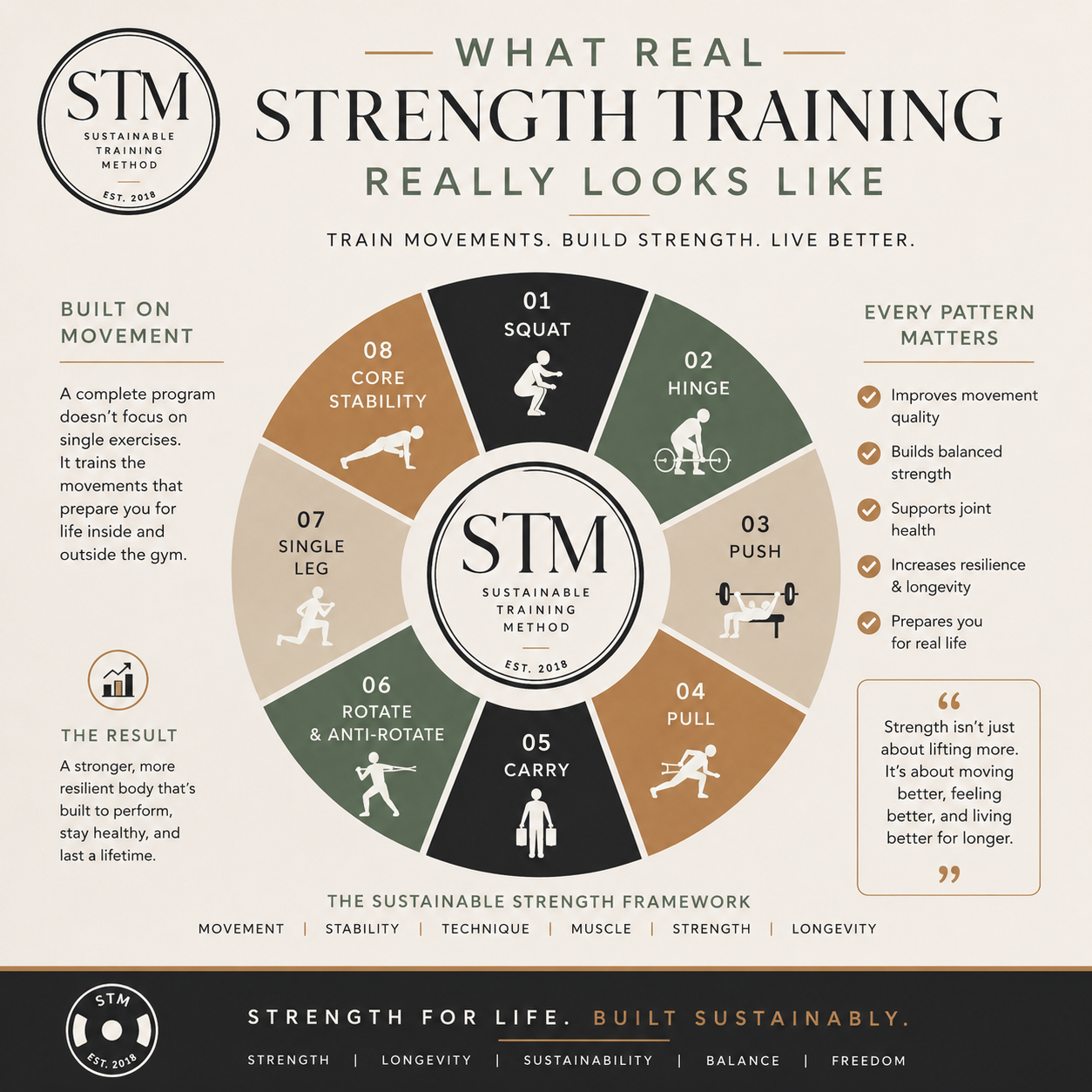
A complete strength program isn't built around individual exercises.
It's built around movement.
Your Body Thinks in Movement, Not Exercises
One of the biggest misconceptions in the fitness industry is that there are a handful of "magic exercises" that solve every problem.
There aren't.
There are no perfect exercises.
There are only exercises that are appropriate for a particular person at a particular stage of their journey.
That's a very different way of thinking.
Your body doesn't think in exercises. It thinks in movement.
Every single day you:
Push
Pull
Squat
Hinge
Rotate
Carry
Reach overhead
Climb stairs
Balance on one leg
Bend down to pick something up
Get up from the floor
Get off the toilet
Life isn't made up of 3 or 4 specific exercises. So why would your training be?
That's why I don't design programs around individual lifts. I build them around movement patterns. Because movement patterns prepare you for life, not just the gym.
Train movements, not just muscles.
The Sustainable Strength Framework
This philosophy sits behind every program I write. Most people believe strength starts by lifting heavier weights. I see it differently.
Movement
↓
Stability
↓
Technique
↓
Muscle
↓
Strength
↓
Longevity
Everything starts with movement. If you don't move well, it's difficult to build strength safely and efficiently. Quality movement improves mobility, flexibility and body awareness without relying on endless stretching.
As movement improves, stability follows.
Better stability allows better technique.
Better technique allows harder training.
Harder training builds muscle.
More muscle leads to greater strength.
As strength increases, your bones receive greater mechanical loading, helping improve bone density over time. The end result isn't simply stronger muscles, joints and stronger bones. It's a body that's more resilient, more capable and better prepared for everything life throws at it.
That's why I call it the Sustainable Training Method.
We're not chasing short-term results. We're building a body that's designed to last.
Strength Exists Where Life Demands It
Take the squat as an example.
Every day I see people performing partial-range squats because they can lift more weight.
The problem is that you'll only become strong in the range of motion you train.
If you never squat deeply, you never build strength, control or confidence in that position.
Over time, muscles and connective tissue also spend less time working in their lengthened positions, which can contribute to reduced mobility.
One of the simplest markers of healthy ageing is the ability to get down to the floor and get back up again independently. That's a movement worth preserving. A well-executed full-range squat helps build the strength, mobility and coordination needed for real life, not just the gym.
Of course, everyone's mobility and anatomy are different. But I'm yet to find a client that can't build the mobility, stability and strength to perform deep squats.
Strength should exist where life demands it.
A Complete Strength Program Trains Every Major Movement
Rather than obsessing over individual exercises, I like to think about movement categories. A complete program should include:
Movement Pattern
Examples
Squat
Goblet squats, front squats, back squats, split squats
Hinge
Romanian deadlifts, conventional deadlifts, hip thrusts, back extensions
Push
Push-ups, bench press, landmine press, overhead press, decline press, dips
Pull
Rows, chin-ups, lat pulldowns, face pulls
Carry
Farmer's carries, suitcase carries
Rotation & Anti-Rotation
Cable rotations, Pallof press
Single-Leg
Lunges, step-ups, single-leg Romanian deadlifts
Core Stability
Dead bugs, planks, carries
Every category develops your body in a different way. Together, they build a body that's capable in the real world.
The Body Is Designed to Work in Balance
One of the biggest things missing from many strength programs is structural balance.
Your body isn't a collection of isolated muscles. It's an integrated system.
Every muscle has another muscle working in opposition to it.
Every joint depends on surrounding muscles working together.
When that structural balance is lost, movement becomes less efficient. Eventually discomfort, reduced performance or injury often follows.
Take the shoulder. It's the most mobile joint in the body. That incredible mobility is also what makes it vulnerable. If your training consists mostly of pressing, you're strengthening one side of the joint much more than the other.
Eventually the muscles responsible for pulling, stabilising and positioning the shoulder begin to fall behind. That's why every pushing movement should be balanced with pulling.
If we strengthen the chest, front deltoids and triceps... We should also strengthen the back, rear deltoids, rhomboids, lower trapezius and rotator cuff.
These muscles don't simply improve posture. They help your shoulders continue functioning well for decades.
Strong pressing muscles without equally strong stabilisers and pulling muscles are like fitting a high-performance engine into a car with worn suspension and no breaks. It's a disaster waiting to happen,
Bilateral Strength Doesn't Always Mean Balanced Strength
Squats, deadlift and bench press are great exercises. I use them regularly.
But they have one limitation.
They're bilateral movements.
Both legs, or both arms work together. The stronger side quietly helps the weaker side. Most people don't even realise it's happening.
Imagine your right hip is considerably stronger than your left.
Every squat.
Every deadlift.
Your right side contributes just a little more.
The movement still looks good. The weight still goes up. But the imbalance remains.
Over months, or years, that imbalance often becomes larger. This is why unilateral exercises deserve a place in every strength program.
Split squats.
Lunges.
Step-ups.
Single-leg Romanian deadlifts.
These exercises expose weaknesses first. Then they allow us to fix them.
Strength is only useful when both sides of your body can produce it.
The Exercises Nobody Talks About
Social media has convinced people that strength training is all about the big lifts.
Squat.
Deadlift.
Bench press.
That's what gets the attention.
What doesn't get attention are the exercises that quietly keep people healthy enough to continue lifting.
Rows.
Hamstring curls.
Calf raises.
Glute bridges.
Farmer's carries.
Face pulls.
Cable rotations.
External shoulder rotations.
Grip training.
Core stability.
These exercises aren't glamorous. You're probably never going to celebrate a personal best on a shoulder external rotation. But they're often the exercises that:
Improve posture
Increase joint stability
Reduce aches and pains
Improve movement quality
Keep your major lifts progressing
This is what many coaches call accessory work. I've never liked that term. It makes these exercises sound optional. They're not.
Think of the big compound lifts as the engine in a car.
Accessory exercises are the steering.
The brakes.
The tyres.
The suspension.
The engine produces the power.
Everything else determines whether the journey is smooth, or whether you end up broken down on the side of the road.
The exercises people skip are often the ones that keep them training for decades.
Small Muscles. Big Responsibility.
Another area that's often overlooked is prehabilitation; or "prehab."
These exercises strengthen the smaller muscles responsible for controlling and stabilising our joints.
They're not glamorous. Nobody posts videos of themselves performing rotator cuff exercises or lower trapezius work. Yet these muscles quietly do some of the most important work in your body.
They improve stability.
Support posture.
Protect joints.
Reduce unnecessary stress during bigger lifts.
Even grip strength, something many people ignore, has consistently been linked with healthier ageing and better overall function.
Small muscles often carry the biggest responsibility. Ignoring them simply because they aren't exciting is one of the easiest ways to limit long-term progress.
Every Exercise Should Answer a Question
Whenever I write a program, every exercise has to justify its place.
I ask myself:
Why is this exercise here?
What movement pattern does it improve?
What weakness is it addressing?
How does it support everything else in the program?
Sometimes the answer is obvious.
A goblet squat teaches posture and movement before progressing to a barbell.
A neutral-grip dumbbell press allows someone with limited shoulder mobility to build strength comfortably.
Split squats improve single-leg stability and hip mobility before heavier bilateral loading.
Nothing is random. Everything has a purpose.
That's why I don't believe in universally "best" exercises. There are only exercises that are right for the individual standing in front of me.
What Does That Look Like In Practice?
No two programs I write are exactly the same. Every exercise is chosen to suit the individual standing in front of me, their goals, movement quality, injury history, experience and training age.
But most programs follow a similar structure. Rather than filling a workout with random exercises, I organise them into three distinct series, with each serving a different purpose.
A Series – Build Strength
The A series contains the primary compound movements.
These are the exercises that place the greatest demand on the body and typically produce the biggest improvements in strength and muscle.
On a lower-body day this might include:
A1: Back Squat or Front Squat
On an upper-body day it might look like:
A1: Incline Bench Press
A2: Chin-Up
A typical prescription might be:
4 sets × 8 repetitions
Tempo: 4-0-0X-0
Rest: 90-120 seconds between exercises
This is where we focus on producing high-quality movement while progressively building strength over time.
B Series – Build Balance
Once the primary lifts are complete, we move into the B series.
These are often what people call accessory exercises, although I don't really like that term because it suggests they're optional. They're not.
Their role is to strengthen supporting muscles, improve structural balance and address weaknesses that the primary lifts don't fully develop.
An upper-body session might include:
B1: Decline Dumbbell Bench Press
B2: Seated Medium-Grip Cable Row
A lower-body session might include:
B1: Front Foot Elevated Split Squat
B2: Lying Hamstring Curl
A typical prescription might be:
3–4 sets × 8–10 repetitions
Tempo: 3-0-1-0
Rest: 60 seconds between exercises
This is where we build muscle, improve symmetry and create the foundation that allows the bigger lifts to keep progressing safely.
C Series – Build Resilience
The final part of the session focuses on the smaller muscles that often receive the least attention, but are some of the most important for long-term joint health.
This is where prehab lives.
For an upper-body session this could include:
C1: Single-Arm Shoulder External Rotation (Prone on a 35° Incline Bench)
C2: Single-Arm Trap-3 Raise (Prone on a 35° Incline Bench)
For a lower-body session it might be:
C1: Standing Calf Raise
C2: Reverse Crunch on an Incline Bench
A typical prescription might be:
3 sets × 10–12 repetitions
Tempo: 3-0-1-0
Rest: 30–60 seconds between exercises
These exercises may never become someone's favourite part of training, but they're often the reason people can continue training consistently for years without developing unnecessary aches, pains or injuries.
When you step back, a clear pattern begins to emerge.
Every session has a purpose.
The A series builds strength.
The B series builds muscle and balance.
The C series builds resilience.
None of these components are more important than the others. Remove one, and the program becomes less complete. Together, they create a body that's stronger, more balanced and better prepared for the demands of everyday life.
Strength Is About More Than The Next Workout
At twenty-five, almost any training program works.
At forty-five, the quality of your movement starts to matter.
At sixty-five, it can determine whether you remain independent.
That's why I don't coach for the next twelve weeks. I coach for the next thirty years.
My Goal Has Never Been To Make You Good At Exercise
When someone starts working with me, they often think my job is to teach them how to squat, deadlift and press. That's certainly part of it. But it's a very small part.
My real goal is much bigger.
I want to build a body that's:
Capable.
Balanced.
Resilient.
Confident.
I want you to move well. To trust your body. To enjoy training rather than fear it.
I want you to carry shopping bags without pain.
Lift your grandchildren with confidence.
Walk up hills without stopping.
Travel.
Garden.
Play sport.
Stay independent.
The exercises are simply tools.
The real goal has never been mastering exercise.
The real goal is building a body that's prepared for life.
Because when you train with that philosophy, something interesting happens.
You don't just improve your muscle.
You don't just improve your strength.
You don't just improve your bone density.
You improve your entire quality of life.
And to me... That's what real strength training looks like.