The first time I heard the word healthspan, something clicked.
We talk a lot about lifespan: how long we live. And on paper, we're doing well. We're living longer than ever. But look around. How many people do you know in their 60s, 70s and 80s who are actually thriving? Strong, sharp, independent, still doing the things they love?
Now think about how many are managing a list of conditions and a cupboard full of medications, just trying to get through the day without too much pain.
It's not only older people, either. We're now seeing type 2 diabetes in kids. I hate to think what life looks like for them by the time they're my age.
That's the difference between lifespan and healthspan. Lifespan is how long you live. Healthspan is how long you live well. And right now, the gap between the two is getting wider.
My wake-up call
I've worked in health and fitness since 2010. If anyone should have had this sorted, it was me.
A few years ago I was living and working in the UK, training hard and, I thought, doing everything right. But I wasn't sleeping well. I had gut issues I couldn't get to the bottom of. And I had no real idea how much my environment was affecting my health.
When I moved back to Australia, I expected things to improve. More sunshine, better food, a healthier lifestyle all round. A lot changed. But my health didn't.
That's when I started working with a functional medicine practitioner, and studied Chris Kresser's ADAPT health coaching program. That's when the penny dropped: health is individual, and you have to look under the hood.
Through blood work and genetic testing, I learned that:
I carry MTHFR gene variants, which affect how well my body detoxifies
My mercury levels were high, and it was affecting my sleep
I have a histamine intolerance
I have haemochromatosis, which means my body stores too much iron, so I now manage it by donating blood
Once I knew what was going on, I could do something about it. I changed my diet to suit my body and cut out ultra-processed food. I cleaned up my environment: the water I drink, the products I use at home and on my skin. I managed my iron. And here's the part that surprised me: I started training less and getting better results.
I've since applied the same approach with my clients, through blood work, better habits and a focus on the basics, and I've seen the difference it makes.
That's why I'm writing this. Not because I have it all figured out, but because I've seen what happens when you stop blaming age and start asking why.
The healthspan gap
In 2024, researchers at the Mayo Clinic looked at data from 183 countries and measured the gap between how long people live and how long they live in good health.
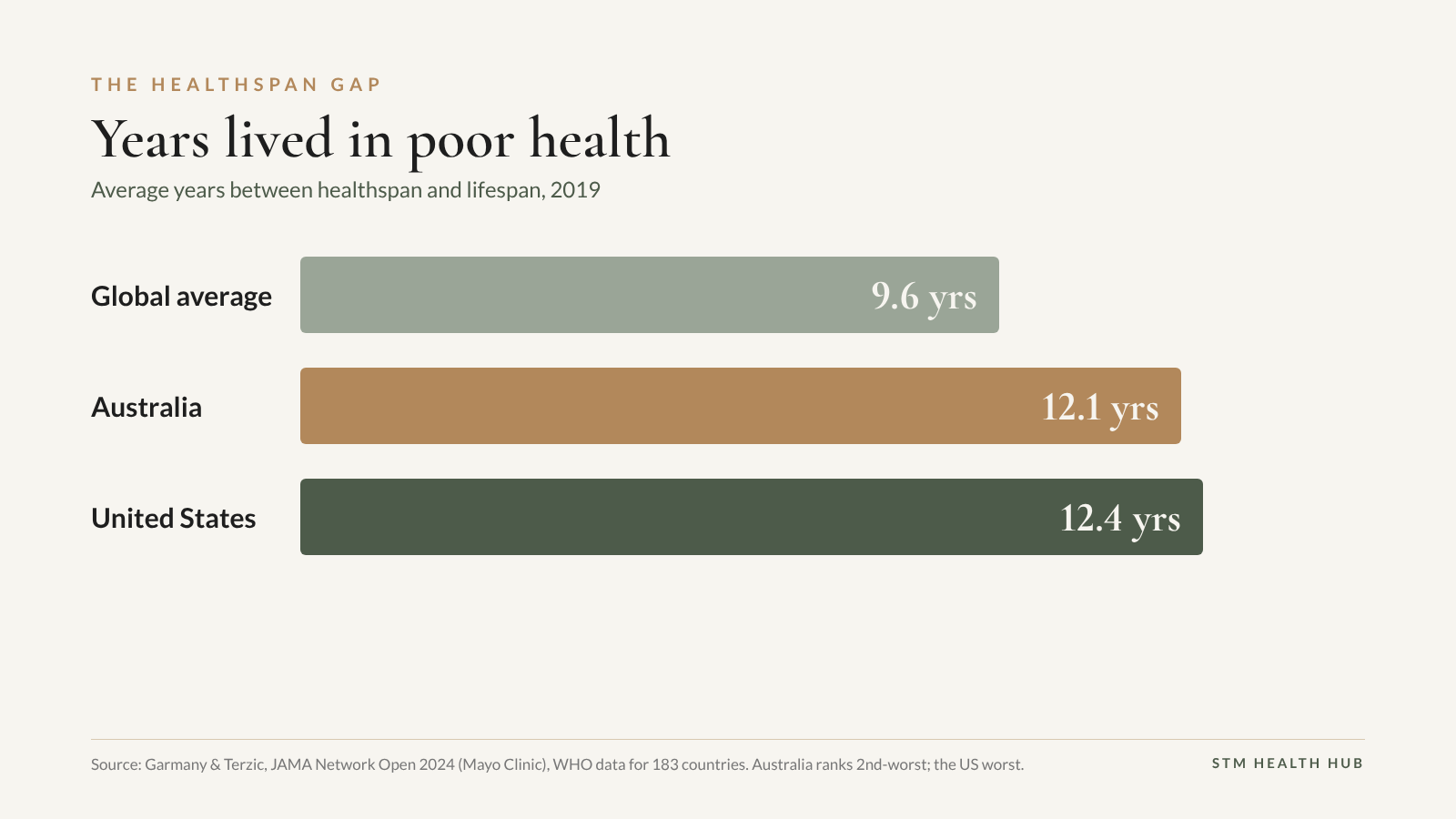
Globally, people spend an average of 9.6 years of life in poor health, up 13% since 2000.
In Australia, it's 12.1 years, the second-worst gap of all 183 countries.
In the US, it's 12.4 years, the widest in the world.
That's more than a decade, for many of us, living with chronic disease, pain or disability.
The UK isn't far behind. Healthy life expectancy there has fallen to its lowest level since records began, at around 61 years. A man born in the UK today can expect to spend 18 years in poor health; a woman 22.5.
And chronic disease is now the norm, not the exception:
61% of Australians live with at least one long-term health condition, and 38% have two or more
3 in 4 American adults have at least one chronic condition
45% of Canadians live with at least one major chronic disease
worldwide, chronic diseases now cause 74% of all deaths, up from 58% in 2000
We've become very good at keeping people alive. We haven't become good at keeping people well.
It isn't just age
It's easy to put sore knees, low energy and a growing list of prescriptions down to "just getting older". But age is only part of the story.
Researchers estimate that 70 to 90% of our chronic disease risk comes from our environment and lifestyle, not our genes. As Chris Kresser argues in *Unconventional Medicine*, with an individualised approach to diet, environment, stress and exercise:
"Most chronic disease is preventable, and much of it is reversible."
The research backs this up:
Five habits, 12 to 14 extra years. A Harvard study following more than 120,000 people found that at age 50, those with five healthy habits (not smoking, a healthy weight, 30 minutes of daily activity, a healthy diet and moderate alcohol) lived around 14 years longer for women and 12 years longer for men than those with none.
Over a third of Australia's disease burden is preventable. The Australian Institute of Health and Welfare estimates 36% of our national disease burden could have been avoided or reduced by tackling modifiable risk factors.
Nearly half of dementia cases. The 2024 Lancet Commission on Dementia concluded that "around 45% of cases of dementia are potentially preventable" by addressing 14 modifiable risk factors, including physical inactivity, high blood pressure, diabetes, hearing loss and social isolation.
Type 2 diabetes can go into remission. In the UK's DiRECT trial, almost half of participants were in remission after a year on a diet-led weight-loss program. Among those who lost more than 10 kg, three-quarters were.
None of this is about blame. Genetics matter, and some things are out of our control. But a huge amount is in our hands. That's the good news.
Why the system misses it
Let me be clear: if you're in a car accident or break a bone, our healthcare system is exactly where you want to be. It's brilliant at emergencies.
But it was built to treat acute illness and injury, not to prevent chronic disease. A standard GP appointment is often 15 minutes or less. That's enough time to hear symptoms and write a prescription, but rarely enough to talk about what you eat, how you sleep, how stressed you are or how much you move. And most doctors get relatively little nutrition training, even though food is the foundation of our health.
This isn't a dig at GPs. Most work incredibly hard inside a system that doesn't give them time for prevention. Even mainstream researchers are calling for change: the Mayo Clinic team behind the healthspan study called for "an accelerated pivot to proactive wellness". As one of the Harvard researchers put it, "we should be putting more effort on prevention than on treatment."
There's also the question of what "normal" means. Standard conventional medicine blood test ranges are usually based on the middle 95% of the people tested, so they tell you whether you're average, not whether you're optimal. Insulin resistance, for example, can be building for years before your fasting glucose crosses the line into "diabetes". And fasting insulin isn't part of most routine blood tests.
There’s an old proverb I keep coming back to:
“A healthy man has a thousand wishes. A sick man has only one.”
Most of us take our health for granted until something goes wrong. It often takes a diagnosis before we slow down and start questioning how we eat, sleep, move and live. And even then, not always.
For many people, the next step is a prescription. Medication can be life-saving, but it’s much easier to take a pill than to change how we eat, train, sleep and manage stress. When medication is the only tool, we treat the symptoms without asking what’s driving them. That’s how so many people end up living longer, but feeling worse.
Those changes take time and energy. But isn’t that what life is meant to be about?
Medication has its place. But for most chronic diseases, the bigger answer lies in how we live.
What we're up against
Go back a few generations and our great-grandparents ate real food, cooked in butter, lard and dripping. They didn't eat out of packets. Many of today's most common diseases were far less common, even among those who lived to old age, before our diets and environments changed so dramatically.
Today, more than half of what the average person in the UK and US eats is ultra-processed food. A 2024 review in the BMJ, covering almost 10 million people, linked diets high in ultra-processed food to 32 harmful health outcomes, including around a 50% higher risk of dying from heart disease, a higher risk of anxiety and depression, and a higher risk of type 2 diabetes.
It's not just what's in our food, but what's been added to it. In 2025, the US Food and Drug Administration announced plans to phase out six synthetic, petroleum-based food dyes by the end of 2026, citing links to hyperactivity in some children.
Where I stand. I'll be honest about my own position, because you deserve to know where I'm coming from:
Seed oils: I don't cook with them. They're highly processed, and our grandparents never ate them. This is debated, and mainstream health bodies still recommend them, but I'd rather cook in butter, ghee, tallow, or lard.
Fluoride: I filter it out of my water. Research has linked higher fluoride exposure to lower IQ in children and to changes in thyroid function. Whether the lower levels in our tap water carry the same risks is still debated, but over a lifetime I'd rather not take the chance.
Glyphosate: the world's most widely used weedkiller. The World Health Organization's cancer agency classed it as "probably carcinogenic". Regulators including Australia's disagree. Expert bodies disagree, so I choose organic for the most heavily sprayed produce where I can.
You don't have to agree with me on all of these. I'll dig into each one, with the evidence on both sides, in upcoming Health Hub posts.
What I'm doing about it
For years, my focus was training. Strength still matters enormously. But I've learned that training is only one piece of the puzzle.
So I'm building the STM Health Hub: a free library of practical, research-backed guides on the five pillars of a strong, healthy life.
Nutrition: real food, cooked well, from good sources
Sleep: the recovery tool most of us underuse
Movement: strength for life, plus everything outside the gym
Stress & mind: a calmer nervous system and a clearer head
Connection: people, purpose, sunlight and time outdoors
Every fortnight I'll share a new topic, with a blog post like this, a newsletter and a free download you can print and use. No extreme protocols and no 30-day overhauls. Just one small swap at a time, because that's what actually lasts.
I'm 45 now, and I think about my health more than I did in my twenties, when a big night out meant a rough day and then I'd bounce straight back. I want to be strong, sharp and independent in my 80s and 90s. Not just alive, but living. I'd love you to come along for the ride.
Your next steps
Download the free Health Wheel. Rate yourself across the five pillars and see where you're thriving and where the easiest wins are hiding.
Pick your lowest pillar and choose one small experiment to try for the next two weeks. Change one thing, not everything.
Join the newsletter so you don't miss the next topic: why small wins beat big overhauls.
Book in a check-up. If it's been a while since your last blood test, talk to your GP about getting one done.
Sources
Garmany & Terzic, Global healthspan-lifespan gaps among 183 WHO member states, JAMA Network Open, 2024. Mayo Clinic summary · ScienceDaily · Australian figure, Scimex
Office for National Statistics healthy life expectancy, via RSPH
Australian Institute of Health and Welfare, Chronic conditions and Australian Burden of Disease Study 2024
CDC, Trends in chronic conditions among US adults, 2025
Statistics Canada, A glimpse at the health of Canadians
WHO Global Health Estimates, via JAMA
Rappaport & Smith, Environment and disease risks, Science, 2010. Summary
Kresser, Unconventional Medicine, 2017
Li et al., Impact of healthy lifestyle factors on life expectancies, Circulation, 2018. Harvard Chan · American Heart Association
Lancet Commission on Dementia, 2024. Optometry Times
DiRECT trial, Newcastle University
Lane et al., Ultra-processed food umbrella review, BMJ, 2024. BMJ Group
FDA synthetic food dyes, CSPI
Fluoride: NTP monograph, 2024 · Thyroid meta-analysis, 2024
Glyphosate: APVMA
Reference ranges: MedicalResearch.com
This post is general information only and isn't medical advice. Please talk to your GP or another qualified health professional before making changes, especially if you have a medical condition, take medication, or are pregnant or breastfeeding.