Two Simple Loading Strategies That Build Real Strength
In last week's article, I wrote about what I call the Goldilocks Weight. Not too heavy. Not too light. Just right.
The article was really about understanding that strength training isn't about putting as much weight on the bar as possible, nor is it about staying comfortable with the same light dumbbells forever. The sweet spot sits somewhere in the middle, where the weight is heavy enough to challenge you, but light enough to maintain good technique, full range of motion, and quality repetitions.
The next question is usually:
"Okay, but how do I actually know what weight to use next week?"
This is where many people get stuck.
Most people walk into the gym and choose their weights based on what the remember doing in their last session. Maybe if they're feeling strong, they try to throw more weight on the bar. If they're feeling tired, they back off. Sometimes they remember what they lifted last week. Sometimes they don't. And while there's nothing inherently wrong with listening to your body, it's difficult to make consistent progress if you're constantly guessing.
This is one of the biggest differences between doing a workout and following a training program.
A workout is simply exercise. Training is a planned progression toward a specific outcome. If your goal is to build strength, build muscle, and remain strong and capable for decades to come, then you need some form of progression strategy.
Today I want to share two of the loading methods I regularly use with clients.
They're not the only options available, but they're simple, effective, and easy to implement.
Method 1: Linear Loading
Linear loading is one of the simplest and most effective ways to build strength.
It's particularly useful for beginners, people returning from injury, or anyone coming back after a period away from training. The concept is simple.
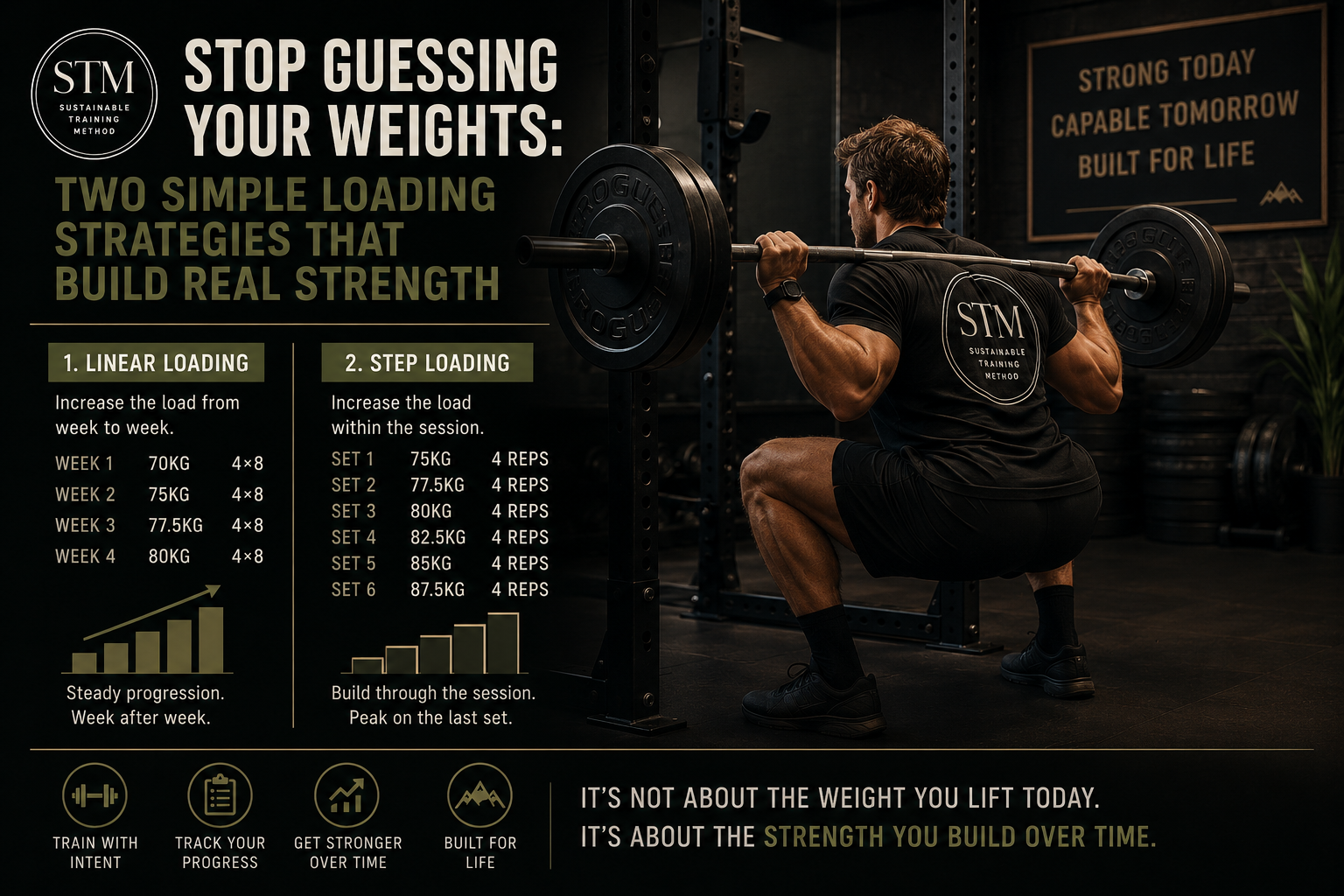
You keep the exercise, sets, and repetitions the same while gradually increasing the load from week to week. Let's use the back squat as an example.
Imagine your program calls for 4 sets of 8 repetitions.
You know you can probably squat 80 kilograms for eight reps, but rather than starting there, you deliberately begin lighter.
In week one, you might use 70 kilograms for all four sets. The goal isn't to find your limit. The goal is to establish a starting point. You leave the gym feeling like you could have done more. That's intentional.
In week two, you increase the load to 75 kilograms.
In week three, you move to 77.5 kilograms.
In week four, you reach 80 kilograms.
Each week builds upon the last. No heroics. No testing. No guessing. Just steady progression.
This approach works incredibly well because it allows the body to adapt gradually. Strength improves, confidence improves, technique improves, and by the time you reach the final week of the phase, you've accumulated a significant amount of quality work.
Most training phases will last somewhere between three and six weeks before the exercises, sets, repetitions, or training emphasis change.
The important thing is that you're looking beyond a single workout. You're thinking about progression across the entire phase. This is exactly how strength and muscle is built.
Not in a single session, but through the accumulation of hundreds of quality repetitions over time.
Method 2: Step Loading
As lifters become more experienced, progression often becomes a little more sophisticated.
This is where step loading can be incredibly effective. Unlike linear loading, where the weight increases from week to week, step loading increases the weight within the session itself.
Let's say your program calls for 6 sets of 4 repetitions on the back squat.
Before you even begin, you'll have a rough idea of what your current strength level is. One of the tools we use for this is an estimated one-repetition maximum, often referred to as an estimated 1RM. Now before people panic, this doesn't mean you need to test a true maximum lift. In fact, most people never need to perform an actual one-repetition maximum.
Instead, we can estimate it based on the weights you're already lifting.
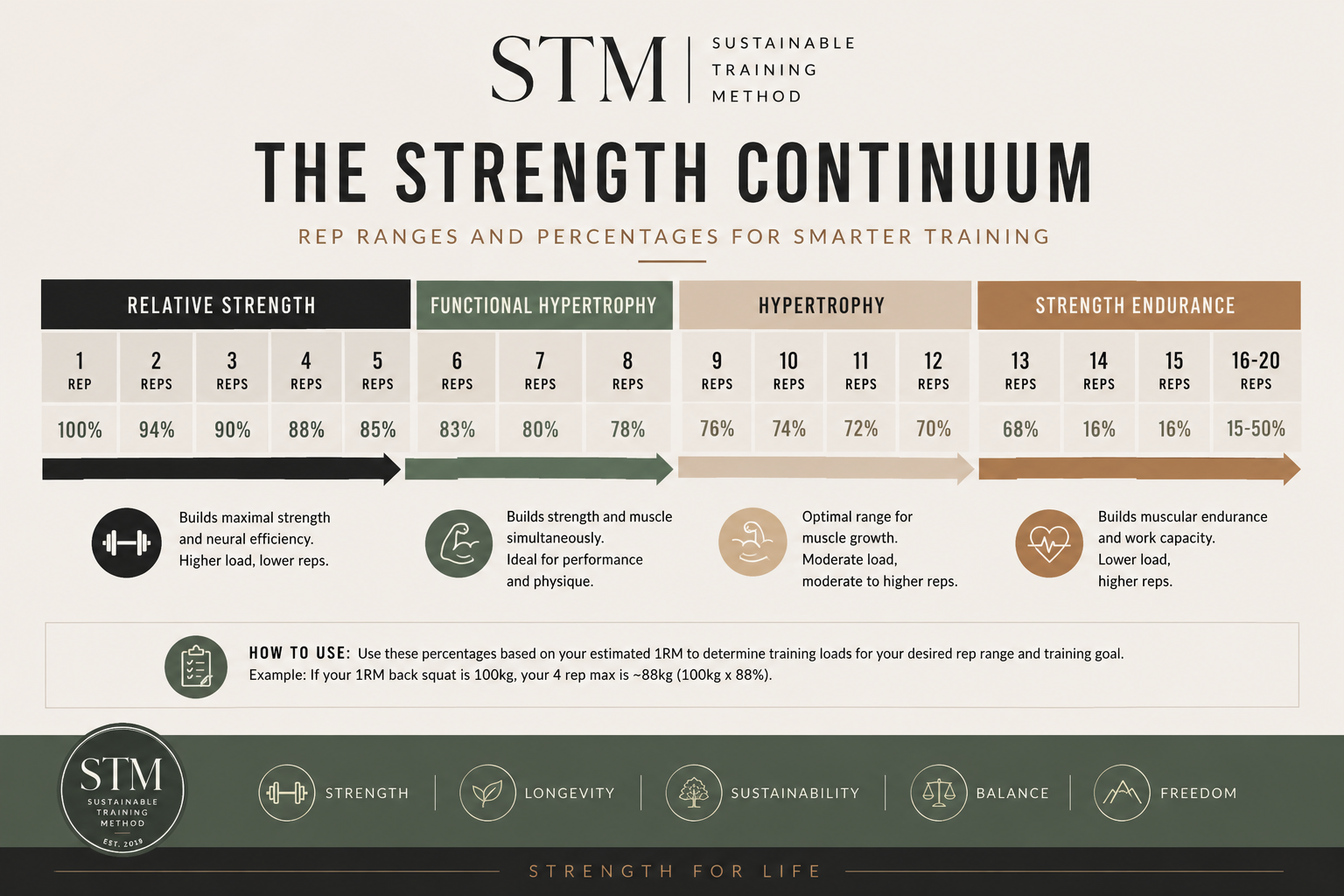
If you can squat 100 kilograms for one repetition, that's obviously your 1RM. But even if you've never tested it, we can use repetition percentages to estimate it. This is where the strength continuum becomes useful.
1 repetition is approximately 100%.
2 repetitions is around 94%.
3 repetitions is around 90%.
4 repetitions is around 88%.
5 repetitions is around 85%.
As repetitions increase, the percentage of your maximum gradually decreases.
Using these percentages allows us to estimate appropriate training loads without constantly testing maximal strength. If your estimated 1RM squat is 100 kilograms, then your estimated 4RM is approximately 88 kilograms.
Now we can begin planning. Rather than using the same weight for all 6 sets, we gradually work toward that top set.
For example:
Set 1: 75kg x 4
Set 2: 77.5kg x 4
Set 3: 80kg x 4
Set 4: 82.5kg x 4
Set 5: 85kg x 4
Set 6: 87.5kg x 4
As the session progresses, the nervous system becomes more activated, more motor units are recruited, and the body prepares itself for heavier loading. The increase isn't dramatic. It's incremental. Small jumps. Small wins.
Over time, those small wins add up. The following week, you assess how the last session felt.
Did the top set move well?
Did technique remain solid?
Did you have more in reserve?
If so, you might increase the top set slightly and recalculate the earlier sets. If not, you may repeat the same loads until the body adapts. Again, there is a plan. A strategy. A progression model.
You're no longer guessing.
The Real Difference Between Exercising and Training
The reason I like both of these loading methods is that they force people to think beyond today's workout.
Too many people approach training with no real system. They don't record their weights. They don't know what they lifted last week. They don't know what they lifted six months ago. And because they aren't tracking progression, they have no way of knowing whether they're actually getting stronger.
They're exercising. But they're not training.
Training implies a destination. It implies a process. It implies progression. If your goal is to build muscle, increase strength, improve your health, and remain independent as you age, then every session should be part of a larger plan.
Not every workout needs to be harder than the last.
Not every session needs a personal best.
But every session should contribute to a long-term outcome. That's what Sustainable Training Method is built upon.
Strength is never a weakness.
Muscle is one of the greatest assets we can build for long-term health. And the best way to build both is through consistent, intelligent progression. Whether you use a linear loading approach or a step loading approach, the principle remains the same:
Stop guessing.
Start tracking.
Follow a plan.
And allow strength to compound over time.
Because the strongest people aren't necessarily the ones lifting the most weight today. They're the ones who are still getting stronger years from now.
Ready to Stop Guessing and Start Training?
One of the biggest benefits of working with a coach isn't motivation. It's having a plan.
Knowing what exercises to do, how much weight to lift, when to progress, and how to adjust training based on your goals, experience, and recovery capacity can make all the difference between spinning your wheels and making consistent progress.
If you're based in Byron Bay, Australia and you'd like to build strength, gain muscle, improve your health, and learn how to train with purpose, I'd love to help. The first step is a consultation where we can discuss your goals, assess where you're currently at, and map out the most effective path forward.
If you're not local, I also work with clients throughout Australia and internationally through online coaching. You'll receive a personalised training program, structured progression, ongoing support, and a clear strategy designed around your lifestyle and goals.
Whether your goal is to get stronger, build muscle, improve body composition, or simply stay capable and independent as you age, the principles remain the same:
Stop guessing.
Follow a plan.
Track your progress.
And let strength compound over time.
Book a consultation to learn more about face-to-face coaching in Byron Bay or online coaching from anywhere in the world.