The Goldilocks Weight: Not Too Heavy, Not Too Light, Just Right
One of the things I've noticed after years of coaching people in the gym is that most people struggle to choose the right weight. Some people are constantly trying to lift more than they're capable of. Others never challenge themselves enough. Both groups end up frustrated because neither approach leads to consistent long-term progress.
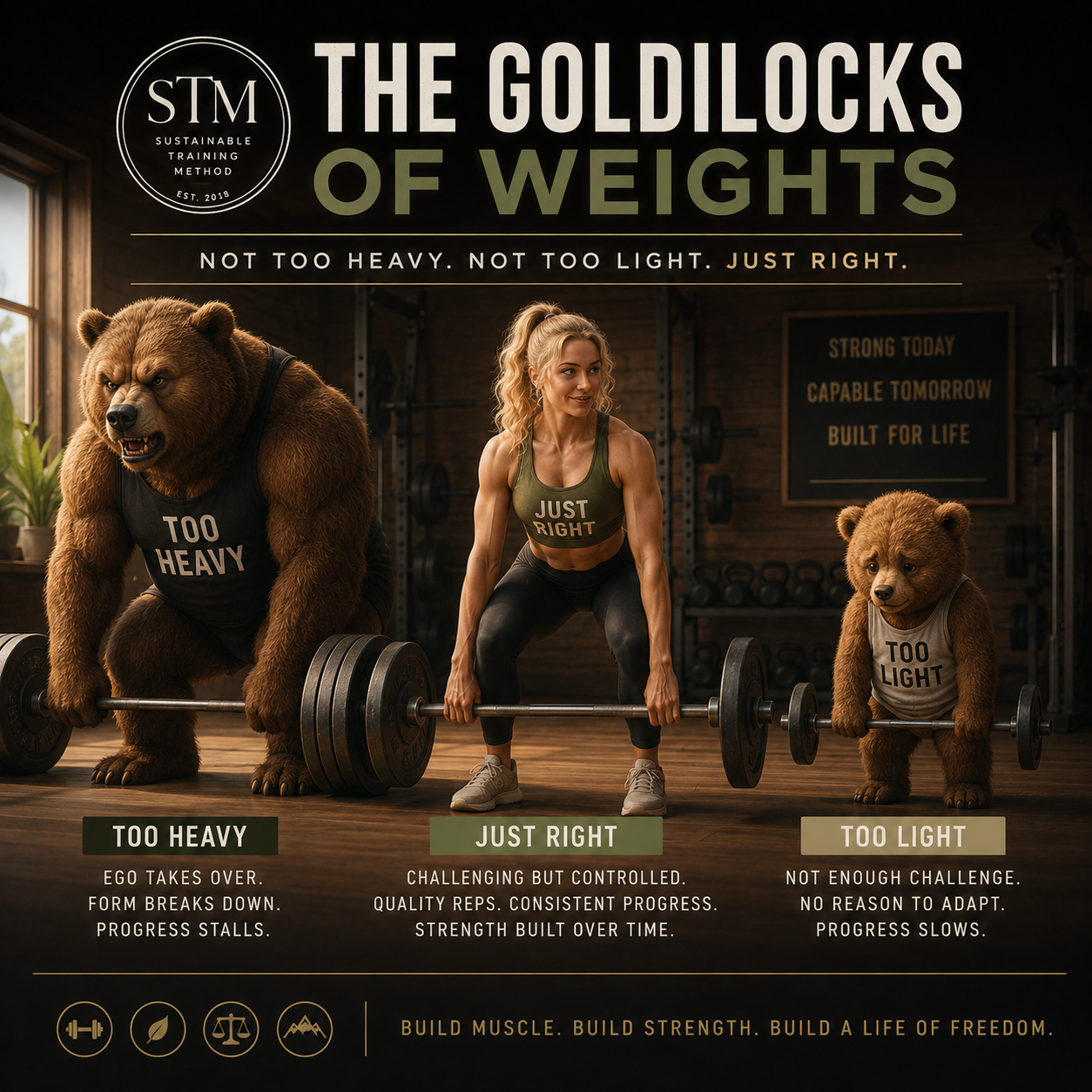
The reality is that strength training works best when the weight is somewhere in the middle. Heavy enough to challenge you. Light enough to control.
Not too heavy. Not too light. Just right.
I call this the Goldilocks weight.
If you spend a few minutes observing people in any commercial gym, you'll quickly notice two extremes.
The first group are the ego lifters.
These are the people loading every exercise as heavily as possible. Their squat gets shallower as the weight increases. Their bench press turns into a bounce off the chest. Their pulldowns become full-body rowing movements. Every exercise becomes a demonstration of how much weight they can move rather than how effectively they can train the target muscles.
I've been guilty of this myself. Most people who enjoy strength training have.
There is something appealing about putting more weight on the bar. It feels like progress. It feels productive. It feels impressive.
The problem is that the body doesn't care about your ego. The body only responds to the quality of the stress you apply.
When the weight becomes too heavy, technique breaks down. Range of motion decreases. Muscles that should be doing the work become bypassed. Momentum takes over. The stimulus shifts away from productive training and towards simply surviving the set.
What most people don't realise is that they are often testing strength instead of building it.
Testing strength and training strength are not the same thing. If your goal is to become stronger, constantly attempting maximal lifts is rarely the best approach. In fact, if we look at the strongest athletes in the world, they provide a completely different model.
Powerlifters don't max out every week.
Olympic weightlifters don't max out every week.
Strongman competitors don't max out every week.
The strongest people on the planet spend most of their training performing submaximal work. They follow structured training plans. They accumulate quality repetitions. They gradually increase training loads over time. They understand that strength is built through consistent exposure to appropriate training stress, not through constantly proving how strong they already are.
Competition is where strength is tested. Training is where strength is built.
The second group are people who never challenge themselves enough.
This is particularly common among beginners and many women who have been told for years that lifting heavier weights will somehow make them bulky. As a result, they spend months or years using the same dumbbells, the same machine settings and the same training loads.
Initially they see progress because almost any resistance training is an improvement over doing nothing. But eventually the body adapts.
Strength plateaus.
Muscle growth slows.
Body composition improvements stall.
The reason is simple. The body only adapts when it is given a reason to adapt. If the challenge never changes, neither do the results. This is where many people become confused about what strength training is actually trying to achieve.
At Sustainable Training Method, strength is never just about lifting heavier weights. Strength is a tool. The real goal is building and maintaining muscle.
Muscle improves metabolic health. Muscle improves insulin sensitivity. Muscle protects joints. Muscle supports posture and movement quality. Muscle helps us remain capable, independent and resilient as we age.
No one reaches seventy or eighty years old and wishes they had less muscle or less strength. The challenge is finding the right amount of load to create adaptation without sacrificing movement quality.
This is where intelligent programming becomes important. When I design a training program for a client, I'm not randomly assigning weights. Every training phase is built around what the client has previously demonstrated they can do.
If a client can bench press 60 kilograms for five repetitions, I can estimate their one repetition maximum. Using standard strength percentages, five repetitions is approximately 85 percent of maximum effort. This gives us a reasonably accurate estimate of what they could potentially lift for a single repetition without actually having to perform a maximal lift.
This information becomes incredibly valuable.
Because once we know an estimated maximum, we can begin working backwards. If I know what a client's estimated 1RM is, I can predict what their likely 3RM, 5RM, 7RM or 10RM should be. I can determine appropriate training loads for different phases. I can structure progression. I can create realistic targets.
Instead of guessing, we can plan.
This is where many recreational gym-goers go wrong. They walk into the gym and decide how much weight to use based on how they feel that day. Strong lifters don't do that. Strong lifters follow a process.
For example, if I know a client's estimated 4RM bench press is 75 kilograms, I may design a four-week strength phase where the final week aims to reach that load or go beyond it.
Week one might finish at 67.5kg kilograms.
Week two at 72.5kg kilograms.
Week three at 75 kilograms.
Week four at 77.5 kilograms.
The client isn't trying to set a personal best every session. They're gradually accumulating quality work and building toward a target. This is often referred to as step loading and it's one of the simplest ways to progress strength while maintaining technical proficiency.
Each week builds upon the previous week. Each phase builds upon the previous phase. Each year builds upon the previous year.
This is how strength is developed sustainably. It's also important to understand that different repetition ranges create different training effects.
Lower repetitions generally allow us to develop maximal strength.
Moderate repetitions are excellent for building muscle and reinforcing movement patterns.
Higher repetitions can improve local muscular endurance and increase training volume.
All of these methods have value.
The mistake is assuming that every exercise should always be trained with the same loading strategy. Good programming moves along the strength continuum depending on the objective of the phase.
Sometimes we are prioritising hypertrophy.
Sometimes we are prioritising maximal strength.
Sometimes we are addressing weaknesses, structural balance or movement quality.
The weights we choose should reflect the goal of the training phase, not our mood on the day. This is ultimately what the Goldilocks weight represents.
It's not a specific percentage.
It's not a specific repetition range.
It's not a specific number on the bar.
It's the load that allows you to train the intended quality while maintaining excellent execution.
Heavy enough to stimulate adaptation. Light enough to maintain control.
Heavy enough to drive progress. Light enough to recover from.
Because the best lifters aren't the ones who impress people with today's workout. They're the ones who are still progressing five years from now. They're the ones building muscle, building strength and building a body that remains capable for life.
That's the real goal of strength training. Not simply lifting the most weight possible today. But becoming stronger, healthier and more resilient for decades to come.
Ready to Find Your Goldilocks Weight?
The challenge with strength training isn't simply working harder. It's knowing how hard to work.
Too much weight and technique breaks down.
Too little weight and progress stalls.
The sweet spot sits somewhere in the middle, and finding that sweet spot is one of the biggest reasons people seek out a coach.
At The Sustainable Training Method, every training program is built around your current strength levels, movement quality, goals, and training experience. We don't guess. We assess, measure, and progressively build strength using the right loads at the right time.
Because strength isn't about surviving today's workout. It's about becoming stronger, more capable, and more resilient year after year.
If you're based in Byron Bay and want to learn how to train properly, build strength, and gain confidence in the gym, I'd love to help. You can find me coaching clients at the Byron Bay gym on Jonson Street.
Not local?
I also work with clients internationally through online coaching. You'll receive a personalised strength program, structured progression, exercise guidance, and ongoing support to help you build muscle, increase strength, and stay accountable.
Whether your goal is to improve performance, build muscle, lose body fat, or simply stay strong for life, the principles remain the same:
Train with purpose. Progress gradually. Choose the right weight. And let strength compound over time.
Book a consultation call to learn more about face-to-face or online coaching