You Have to Earn the Right to Lift Heavy
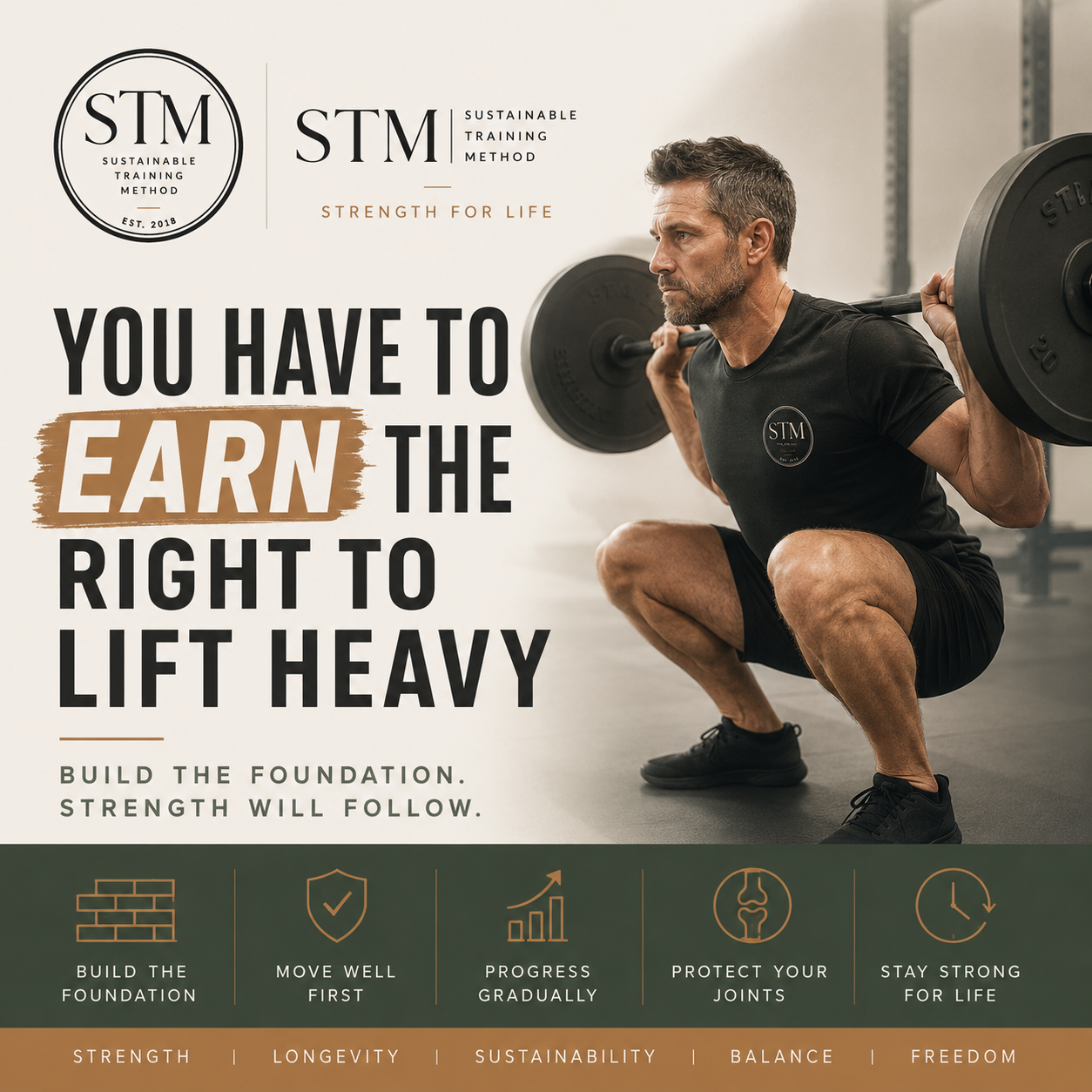
One of the sayings I use with almost every client is this:
"You have to earn the right to lift heavy."
At first, people usually laugh. Some think I'm trying to slow them down. Others think I'm being overly cautious. The truth is exactly the opposite.
I'm trying to help them get stronger, and stay stronger, for the next twenty or thirty years, not just the next twenty or thirty days.
In my last post "Is ONERO Strength Training Safe? A Strength Coach's Perspective", I wrote about the problem I see many adults making in the gym by trying to lift too heavy too soon.
One of the biggest misconceptions in strength training is that strength is measured purely by the amount of weight on the bar. It's not.
The weight matters, but it's only one part of the equation. Real strength is the ability to produce force with control.
It's moving well under load.
It's going through a full range-of-motion under load.
It's owning every repetition.
It's being stable through your joints, confident in your movement and able to repeat that performance consistently.
That's the kind of strength that keeps you training for decades. And if your goal is improving bone density, it's exactly the kind of strength you should be chasing.
Your bones don't know whether you're holding a barbell, a dumbbell, using a cable machine or performing a bodyweight exercise. They simply respond to mechanical loading, the same as your muscles and connective tissues.
As that loading gradually increases over time (progressive overload), your bones receive the signal to remodel and become stronger.
Notice the word gradually.
That's the part so many people overlook. The problem isn't lifting heavy. The problem is trying to lift heavy before your body is ready.
Build the Foundation Before You Build the House
Imagine you were building your dream home.
You wouldn't start by putting the roof on first.
You wouldn't install expensive windows before the concrete slab had even cured.
Every great house starts with a solid foundation because everything else depends on it.
Strength training is no different.
Before you ask your body to squat, deadlift or press heavy weights, it needs to develop the qualities that make those movements safe and effective.
Can you perform deep squats without your knees collapsing in or your torso excessively leaning forward?
Can you hinge through your hips instead of your lower back?
Can you press overhead without compensating through your spine (arching you lower back)?
Can you control the weight from start to finish instead of simply surviving the lift?
These aren't small technical details. They're the foundation that determines whether you'll still be making progress in ten years or dealing with injuries that could have been avoided.
One of the things I've learnt after coaching hundreds of people is that no two bodies are the same. Some people have old sporting injuries. Others have arthritis. Some have spent decades sitting behind a desk or performing shallow squats in the gym.
Others have naturally great mobility.
That's why there isn't a single exercise that's right for everyone. There are only exercises that are appropriate for the individual standing in front of you.
Good coaching is about meeting someone where they are, not where we wish they were.
More Weight Doesn't Improve Poor Technique
Here's something I've seen countless times over the years. Someone struggles to squat with good technique.
Their knees collapse.
Their heels lift.
Their torso folds forward.
So what do they do? They add more weight.
For some reason, people assume that heavier weights somehow force better technique. Unfortunately, the opposite is usually true.
Weight magnifies whatever movement pattern already exists. If your bodyweight squat isn't deep and stable, adding a barbell won't suddenly fix it.
If your shoulders aren't stable with a light overhead press, doubling the load won't magically improve your movement.
If your deadlift relies on your lower back instead of your hips, increasing the weight simply increases the stress placed on the tissues you're trying to protect.
The weight doesn't hide weaknesses. It exposes them.
That's why experienced coaches spend so much time teaching quality movement before chasing numbers. Not because they're being conservative. Because they understand that good movement is what allows progress to continue year after year.
Your Bones Aren't the Only Things Adapting
One thing that rarely gets discussed in conversations about bone density is connective tissue.
Everyone talks about muscles.
Everyone talks about bones.
Very few people talk about tendons.
Ligaments.
Joint capsules.
Cartilage.
Yet these tissues are just as important.
When you begin strength training, your muscles often adapt surprisingly quickly. Within a few weeks you'll usually notice you're getting stronger. That's exciting.
But connective tissue works to a very different timeline. Tendons and ligaments remodel slowly. Sometimes painfully slowly. They need months of consistent loading before they become stronger and more resilient.
If your muscles get stronger faster than your connective tissue can adapt, you create a mismatch.
Your muscles may be capable of lifting the load.
Your joints may not yet be capable of tolerating it.
That's often where injuries begin.
This is why progressive overload is one of the most misunderstood principles in strength training. Progressive overload doesn't simply mean adding more weight every week.
Sometimes progress means move volume (more sets or reps).
Sometimes it means improving your technique.
Sometimes it's increasing your range of motion.
Sometimes it's slowing the movement down and controlling every centimetre.
Sometimes the biggest win isn't lifting more weight. It's moving significantly better than you did a month ago.
Strength Is a Skill
I don't think strength is something you either have or you don't. I think strength is a skill. And like every skill, it improves through deliberate practice.
Nobody expects to sit down at a piano for the first time and play beautifully.
Nobody expects to pick up a golf club and hit every shot perfectly.
Yet every week I see people walk into a gym expecting to perform technically demanding lifts with little or no coaching.
The squat.
The deadlift.
The overhead press.
These aren't just exercises. They're skills.
They require coordination.
Balance.
Mobility.
Stability.
Timing.
Body awareness.
The better your movement becomes, the more efficiently your body transfers force. The more efficiently your body transfers force, the stronger you become. Ironically, the strongest people I've ever worked with weren't obsessed with lifting heavier every session. They were obsessed with mastering the basics and moving well.
Confidence Before Intensity
One of the biggest differences I notice when coaching older adults isn't strength.
It's confidence.
Many people are afraid of hurting themselves.
Afraid of falling.
Afraid of doing something wrong.
Good coaching changes that.
I remember working with a client in her late sixties who arrived convinced she needed to squat heavy as quickly as possible because she'd been told it was the best exercise for improving bone density.
The problem wasn't her motivation. The problem was that she couldn't comfortably squat below parallel due to tightness in her ankles and hips.
Instead of doing back squats, we spent several weeks improving her hip mobility, strengthening her glutes and core, stretching her tight calves, and teaching her what a proper squat actually felt like.
We progressed from bodyweight hack squats, heels elevated goblet squats, to box squats, and eventually to barbell back squats.
By the time she was lifting weights she never imagined possible, her technique was solid, her confidence had completely changed and, most importantly, she could squat deep with a barbell on her back.
That's what good coaching looks like. Not rushing someone into heavy lifting or feeding their ego. But helping them earn the right to lift heavy.
The Long Game Always Wins
If there's one thing I'd love every reader to remember, it's this:
There is no prize for getting strong quickly. The prize is still being strong twenty years from now.
Your bones don't care how much you lifted this month. They care about the cumulative effect of years of intelligent, consistent training. That's the real secret.
Not chasing the heaviest weight.
Not comparing yourself to the strongest person in the gym.
Not forcing progress before your body is ready.
Simply showing up. Moving well. Building muscle.
I often tell clients:
Allow your form to dictate the load and not the other way around.
Progressively challenging your body.
Recovering properly.
Then doing it again next week. And the week after that.
Strength isn't built in a workout. It isn't built in six weeks. It isn't even built in six months. Real strength is built over years. When you approach training with that mindset, something remarkable happens.
You don't just build stronger bones.
You build stronger muscles.
Healthier joints.
Better balance.
Greater confidence.
More resilience.
You build a body that's capable of carrying you through life. Because that's what sustainable strength really means. It's not about proving how strong you are today. It's about building a body that's still strong enough to enjoy life tomorrow. And twenty years from now.
That's the kind of strength worth investing in.